R O M A N S
the world according to God
b y C. J e f f R i c h a r d s o n
I would like to thank the patient and long-suffering participants of the class at the West Side Church of Christ that sat through my first experience at teaching Romans in the summer and fall of 1997. Their feedback, encouragement, insight and criticism has, I believe, made me a better teacher and helped me learn a lot about Romans, too!
This material is not purported or intended to be original insight into the Romans text. Rather, it is a combination of my own views, excellent commentaries (especially Paul Achtemeier’s commentary from which the entire class structure was based), and generous discussion and insight from the original class. It is intended to be a class room guide for teaching Romans. And, as such, provided below is the class schedule that I used during the development and presentation of this material. As can be seen, the final chapters (especially 12-15a) suffer from the twenty-two week course. Preferably, the class would stretch across two quarters (26 classes in all) and allow greater expansion on the material in chapters 12-16.
|
Date |
Class |
Passage |
Title |
|
07/02/97 |
1 |
NA |
Background & Philosophy |
|
07/09/97 |
2 |
NA |
Romans as a Letter |
|
07/16/97 |
3 |
1:1-13 |
Introduction |
|
07/23/97 |
4 |
1:14-23 |
Idolatry |
|
08/06/97 |
5 |
1:24-32 |
Permissiveness |
|
08/13/97 |
6 |
2:1-16 |
No One Is Excluded |
|
08/27/97 |
7 |
2:17-29 |
The Disadvantage of the Jews |
|
09/03/97 |
8 |
3:1-8;9-20 |
The Advantage of the Jews/Universal Sin |
|
09/10/97 |
9 |
3:21-30 |
Universal Faith/Calvinism |
|
09/17/97 |
10 |
4:1-22 |
Law, Promise & Faith: The Law's True Intent |
|
09/24/97 |
11 |
4:23-5:11;12-21 |
Present Grace and Reconciliation/Adam & Christ/Original Sin |
|
10/01/97 |
12 |
6:1-14 |
Sin and Grace (baptism) |
|
10/08/97 |
13 |
6:15-23 |
Grace, Sin & Bondage |
|
10/15/97 |
14 |
7:1-6 |
Law, Grace & Bondage/Flesh, Letter & Spirit |
|
10/22/97 |
15 |
7:7-25 |
Law & Sin/Total Depravity |
|
10/29/97 |
16 |
8:1-17 |
The Spirit & the Flesh/Irresistible Grace |
|
11/05/97 |
17 |
8:18-39 |
The Spirit, the Future, and Christian Assurance/Perseverance of the Saints |
|
11/12/97 |
18 |
9:1-29 |
God's Grace and Israel's Rejection/Divine Election & Predestination |
|
11/19/97 |
19 |
9:30-10:21 |
Grace, Faith & The Purpose of Law |
|
11/26/97 |
20 |
11:1-36 |
Israel & Her Future with God |
|
12/03/97 |
21 |
12:1-15:13 |
The Community, the State, the Neighbor, the Unity of Faith & Grace |
|
12/10/97 |
22 |
15:14-16:27 |
Paul's Ministry/Greetings & Summation |
Throughout the history of the church, lives have been radically transformed through the impact of Paul’s Epistle to the Romans. Augustine, in 386, was sitting in the garden of a friend, weeping, as he considered making a radical change in his life. The words of a young neighborhood child singing a tune reached his ears, words which invited him to "Take up and read." He took up the scroll nearby, a scroll which contained these words from Paul’s Roman epistle: Not in rioting and drunkenness, not in chambering and wantonness, not in strife and envying. But put ye on the Lord Jesus Christ, and make not provision for the flesh, to fulfill the lusts thereof (Romans 13:13b-14).
Augustine later wrote about his response to these words from the pen of the apostle Paul: "No further would I read, nor had I any need; instantly, at the end of this sentence, a clear light flooded my heart and all the darkness of doubt vanished away (Confessions, viii. 29). The impact which Romans would have on Augustine, and the impact which Augustine would have on the world, can still be seen.
Many years later, in November of 1515, Martin Luther, an Augustinian monk who was a professor at the University of Wittenberg, began to expound the Book of Romans to his students. The more he studied the Epistle, the more he recognized that the Pauline doctrine of justification by faith was central and crucial to the argument of the Epistle. But he found himself struggling to understand it. He describes his struggle with this Epistle and his dramatic conversion when the message came clear to his mind, heart, and soul:
I greatly longed to understand Paul’s Epistle to the Romans, and nothing stood in the way but that one expression, ‘the righteousness of God,’ because I took it to mean that righteousness whereby God is righteous and deals righteously in punishing the unrighteous . . . . Night and day I pondered until . . . I grasped the truth that the righteousness of God is that righteousness whereby, through grace and sheer mercy, he justifies us by faith. Thereupon I felt myself to be reborn and to have gone through open doors into paradise. The whole of Scripture took on a new meaning, and whereas before ‘the righteousness of God’ had filled me with hate, now it became to me inexpressibly sweet in greater love. This passage of Paul became to me a gateway to heaven.
Over two-hundred years later, John Wesley was transformed by this same Epistle. As he wrote in his journal, he:
. . . went very unwillingly to a society in Aldersgate Street, where one was reading Luther’s Preface to the Epistle to the Romans . . . . About a quarter before nine while he was describing the change which God works in the heart through faith in Christ, I felt my heart strangely warmed. I felt I did trust in Christ, Christ alone, for my salvation; and an assurance was given me that he had taken my sins away, even mine; and saved me from the law of sin and death.
The tone of Romans is theological. It is unlike many of Paul’s letters in many ways. First, it offers no apparent fixes for problems at the Roman church - Paul isn’t dealing with specific doctrinal or moral problems. We will attempt to set Romans in proper perspective to Paul’s own viewpoint on theology and in tune with the historical problems that were occurring at the time of the writing of the letter. Specifically, the problem of the Jews and God’s promise to them.
The approach and textual outline used in this study is largely based on that of Paul J. Achtemeier’s used in Romans: A Bible Commentary for Teaching and Preaching (Louisville: John Knox Press, 1985). William Barclay’s The Letter to the Romans: The Daily Study Bible Series (Philadelphia: The Westminster Press, 1975), F. F. Bruce’s The Epistle of Paul to the Romans (Grand Rapids: Wm. B. Eerdman’s Publishing Company, 1969), and Jimmy Allen’s A Survey of Romans (Harding College Press, 1973) also provided valuable assistance in the preparation of this study.
It would be a mistake to read Romans (or any biblical document) as if it were written in a cultural, philosophical or historical vacuum. One of the first steps to good interpretation of Romans will be to get an idea of the reigning philosophies of the time.
There were four key philosophies prevalent at the time of Paul that guided how people understood and expressed religious and moral truth. Paul will deal with three of these philosophies in Romans and he will use the fourth to build the entire letter upon.
The first two philosophies were predominant in the Greco-Roman world:
1. The first of these was a kind of popularized Platonism that divided reality into two domains: the spiritual (good) and the material (evil). This is a departure from classical Platonism in a few ways, and it eventually leads to the heresy known as gnosticism seen developing in later New Testament documents. To Gnostics, God has acted in history at some time in the past to impart knowledge to mankind. After this, however, God no longer involves himself directly in human affairs - it is up to the individual to make their way to wisdom, enlightenment and spirituality. Chapter 7 of Romans will deal with this attitude toward reality and human existence - in fact, in common interpretation, Paul is actually advocating Gnostic thought. We will see why this traditional view doesn’t fit with Paul’s teachings elsewhere, and specifically, not with the argument being presented in Romans.
2. The second prevalent philosophy was a form of stoicism which sought to achieve a moral life through a renunciation of dependence on anything outside the individual. Only an attitude of complete emotional detachment would enable one to remain free of the influence of evil. Again, while Paul sounds stoic at times (e.g., I Corinthians 7:29-31), his other teachings clearly indicate otherwise. Further, the exposition Paul makes of the Jews in history will show how they have at times adopted a stoic approach to God and why this is not acceptable.
In addition to these two philosophies, the Jewish culture also offered two interpretive models:
3. During the time of Paul, Rabbinical Judaism was being developed. Following the destruction of Jerusalem in 70 AD, this became the predominant form of teaching in Judaism, and remains so today. This understanding of the God’s relationship with man put the covenant between God and Israel at the center of its teaching. If the Jews as God’s chosen people fulfilled the Law given by God, they could be sure of fulfilling God’s will for them in all of life. Paul will deal with this approach to God in chapter 4.
4. The fourth philosophy prevalent at the time of Paul’s writing was the Jewish apocalyptic worldview. This worldview developed from some of the views of the prophets, who emphasized that God was in control of history, shaping events in accordance with his will. After the prophets ceased to appear, some assumed that the world had become so evil that it could only be changed by a radical divine intervention. Acknowledging with the prophets that God’s purpose was to lead all of history to the goal he had set for it, they awaited a final judgment on all powers of evil, in which those powers would be completely destroyed. Because God does not reveal these plans to us, this view became known as apocalyptic - meaning "revealed" in the Greek. The key idea in the apocalyptic view is that history is telling us something; that God is acting in history, that he is in control and that he is leading history somewhere.
The first three worldviews are dealt with in Romans and their errors are corrected. The fourth view, the apocalyptic view, is modified and endorsed by Paul as the proper way to look at human history. It is further, I believe, the framework upon which Paul writes this letter.
Romans as Historical Narrative
Romans is normally studied as a compilation of doctrine. That is, the letter itself is broken down into doctrinal topics and is studied as though the purpose of the letter were to list and explain these doctrines.
While it is apparent that Romans does contain a wealth of doctrinal information, I believe this approach to the letter presents too many problems within the text to be the framework upon which Paul is writing.
Numerous commentators using the doctrinal framework encounter great difficulty with the numerous passages referring to the Jews. Most dismiss this as some sort of irrelevant digression from the thread of Paul’s argument about the doctrines of justification by faith or the righteousness of God. But for such central passages as 2:17-3:8 and chapters 9-11 to be considered as secondary or irrelevant to the message of Paul certainly seems to do a disservice to the importance Paul (and the Holy Spirit) had given them.
So what other framework could the letter be built upon? If Romans is not an explication of the doctrines of salvation by faith, what is it?
I believe the correct framework to use in an interpretation of Romans is Paul’s modified apocalyptic view. That is, the proper way to read and study Romans is as a historical narrative about God’s interaction with humanity.
If Paul is using the story of God acting in human history as the basis for his writing in Romans, we would expect Paul to spend a good deal of time on the Jews - since it is this chosen people that God has, until Christ, limited his personal interaction with. When Romans is viewed in this way, the passages concerning the Jewish people are no longer secondary digressions from the main theme of the letter; rather, they are central to the point Paul is making.
In the final analysis, to approach Romans as a doctrinal text and to use 1:17 as the theme verse (the common understanding), simply doesn’t seem to make sense of the letter as a whole.
The historical narrative approach, on the other hand, still produces the doctrinal truths contained in Romans, but also integrates the letter into a powerful argument for how Paul wants us to understand God, his covenant with Israel, and his faithfulness to his people.
The sweep of Paul’s thought runs from the beginning of humankind in Adam to its final fate in the Second Coming. For Paul the history of humanity prior to Christ is under the power of the sin introduced by Adam (chs. 1:18-3:20). As all human beings are related to Adam and to his disobedience by their physical birth, so Christians have come to be related to Christ and to his obedience by their new birth, baptism (6:3-11).
Related to that sweep of human fate is the path of a chosen people. Here, the related concepts are Abraham with whom a chosen people begins and limited by physical race and the church, open now to all who are children of Abraham by being related to the faith of Abraham and upon whom the title "chosen people" has fallen after the resurrection of Christ (chapter 4).
Approaching Romans as a historical narrative is, admittedly, a different way to study the text than is commonly used. And, arguably, it is more time consuming. However, while it may seem more expedient to simply "get to the point" of Romans by identifying doctrines in the text, when the letter is properly studied as a coherent document, a great wealth of insight and understanding about God and his relationship with us is revealed that will be lost if a mere "bottom line" approach is taken. It is precisely because Romans is such a profoundly important letter pregnant with powerful doctrine and knowledge about God and our place in his creation that we must approach it with great respect and care.
Given below is a diagram representing Paul’s version of the apocalyptic view:
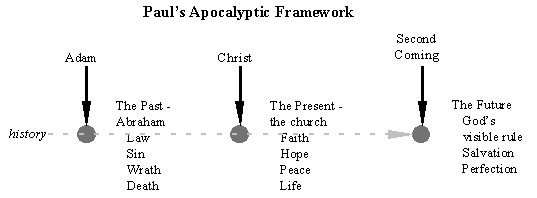
The Relationship Between Creator and Creation
In addition to viewing Romans as being a historical narrative about how God, the Creator, relates to humankind, the creation, we must understand this relationship between Creator and creation in Romans.
1. When Paul discusses the Creator and creation, he carries a presumption that the creation cannot survive apart from the Creator - it is only when we enjoy the favor of the Creator that we can survive. And because God is Creator, he can depose over us his will (see 9:20-24). God, therefore, has every right to judge the creation and his wrath against an unrighteous creation is completely justified. This may seem obvious, but we must understand that God’s continued tolerance of the creation despite its wild rebellions tells us something about God’s relationship to us.
When God bestows this favor - without which the creation cannot survive - Paul calls is "grace". When the creation accepts this favor, Paul calls it "faith" or "trust" - the same word in the Greek.
2. Further, only the Creator has the power to shape his own destiny. Only the Creator, not the creature, is fit to exercise lordship. It was Adam’s desire to exercise lordship that led to his sin. This is critical to understanding Romans - we don’t exercise lordship not because God refuses to let us, but because, as creation, we are not capable of exercising lordship. In this way, we see that humanity will always be serving some lord - we are not free to be without lordship. And only God is fit to exercise lordship. Thus, when the creature rebels against God, we become slaves to the forces that oppose God. We are then powerless to free ourselves from this lordship of sin. Only a power greater than sin can free us from our enslavement.
This way of understand our condition as creation has a powerful corollary in moral and ethical space.
3. It will do no good for the person in sin to "try harder" to do right. As Paul makes clear in chapter 7, a human being "under Adam" is incapable of freeing himself or herself from sin - and "trying harder" only drives that person further into sin. If every act is under the control and enslavement of sin, more action will simply mean more sin. It is only after the power of sin has been broken - and that is only after the lordship of God has been restored - does it make sense to give admonitions on how one is to live so as to avoid sin.
4. A further corollary is that the creature confronting the gospel does not confront the gospel on neutral ground. As children of Adam, we are under sin - we are enslaved to it when we are outside of Christ. We are not standing in a hallway choosing between two doors, we are in the room of sin looking out to the doorway of God. Not to choose the gospel, therefore, is to choose sin. The only choice is whether we will accept the gracious lordship of God thereby ending our rebellion. Failing that choice, we remain in sin, ruled over by a power beyond our control.
Author, Date and Place of Writing
The book was probably written by Paul (1:1) in the early spring of 57 AD. His work in the eastern Mediterranean was almost finished (15:18-23), and he greatly desired to visit the Roman church (1:11-12; 15:23-24). At this time, however, he could not go to Rome because he felt he must personally deliver the collection taken among the Gentile churches for the Jerusalem church (15:25-28). So instead of going to Rome, he sent a letter to prepare the Christians there for his intended visit in connection with a mission to Spain (15:23-24). For many years Paul had wanted to visit Rome to minister there (1:13-15), and the letter served as a careful and systematic theological introduction to that hoped-for personal ministry. Since he was not acquainted with the Roman church, he says little about its problems.
Paul had nothing to do with the founding of the church in Rome nor had he yet been to Rome at the time of the writing of his Epistle to the Romans. He had heard reports about the faith of the Romans (1:8). He had made the Roman church a matter of persistent prayer. He looked forward to the day when he could visit the church in Rome to minister to these saints, as well as to be encouraged by their faith. His Epistle to the Romans was apparently written because of his delay in reaching Rome and perhaps in preparation for his coming. It is most interesting that one of Paul’s longest and most fully developed books was written to those whom he did not know personally.
Since he had not yet been at Corinth when he wrote to that church (cf. 1 Corinthians 16:1-4; 2 Corinthians 8-9), the writing of Romans must follow that of 1, 2 Corinthians (dated c. 55 AD).
The most likely place of writing is either in Corinth or Cenchrea (about six miles from Corinth) because of the references to Phoebe of Cenchrea (16:1) and to Gaius, Paul's host (16:23), who was probably a Corinthian (see 1 Corinthians 1:14). Erastus (16:23) may also have been a Corinthian (see 2 Timothy 4:20).
Paul eventually reached Rome but not in the way he might have expected. He arrived as the "guest" of the Roman government, as a prisoner who was appealing his case to Caesar as a Roman citizen. Upon his arrival, he was warmly greeted by the brethren and encouraged, as he had hoped:
. . . and thus we came to Rome. And the brethren, when they heard about us, came from there as far as the Market of Appius and Three Inns to meet us; and when Paul saw them, he thanked God and took courage (Acts 28:14b-15; compare Romans 1:11-12).
Paul’s first visit to Rome lasted, it seems, for two full years (Acts 28:30). While Paul was not free to travel about Rome, he was free to have visitors at his rented quarters, and so he was able to minister to all who came to him (28:30).
The general consensus is that the original recipients of the letter were the people of the church at Rome (1:7; but see discussion below), who were predominantly Gentile. Because of the predominant approach of interpreting Romans as a strictly doctrinal text, some have concluded that 2:17-3:8, chapters 4 and 9-11 are indicative of a substantive Jewish group among the Christians at Rome. This leap is not necessary when studying Romans from a historical perspective.
From secular history, we know that in Rome the Jews were not well thought of nor kindly treated at various times. Claudius, for example, expelled the Jews from Rome (Acts 18:2) which was not the only time this happened. It would be only a few years after this Epistle to the Romans was written that Rome would be destroyed by fire and that Christians would serve as scapegoats for this atrocity. Soon would come the day when Christians would be fed to the lions at Rome. This may have set the scene for the martyrdom of both Peter and Paul, as well as many others.
Extant manuscripts containing shortened versions (containing all but chapters 14-16) of the letter may indicate that a shorter form was generated for more general distribution. We have preserved multiple copies of this letter from a variety of sources and at varying stages of history. Some of these manuscripts either omit these last chapters or contain only pieces of them. The prevailing explanation for this is that the letter was initially sent to Rome, but was immediately recognized as having applicability to far greater circles (no doubt this became especially true after Paul was executed). It was and is thought of as the quintessence of Paul’s writings and a sublime summary of the redemptive plan of God. Thus, scholars contend that copies were made omitting the location-specific greetings and personal notations to make the letter more palatable to a larger audience. The letter would have then been circulated to numerous churches.
Another issue regarding the recipients of the letter is somewhat more problematic. Paul, in the final chapter of Romans, sends greetings to over twenty people at the church to whom he is writing. One wonders how this can be since it is clear that at the time of the writing, Paul has never set foot in Rome. In fact, Paul sends more greetings in this letter than in any other. How can this be explained? On the basis of this problem, many have concluded that the sixteenth chapter was not a part of the letter to the Romans at all, but was attached to a letter addressed to another church.
If, however, this chapter wasn’t written to Rome, where was its original destination? We know, for instance, that Priscilla and Aquilla left Rome in 52 AD when Claudius banished all Jews (Acts 8:12). We also know they were with Paul in Ephesus (Acts 18:18) and that they were with him when he wrote his letter to Corinth less than two years before he wrote the letter to the Romans (1 Corinthians 16:19). And we also know they were still in Ephesus when the Pastoral Epistles were written (2 Timothy 4:19). So, without other information being given, we would be justified in assuming a letter containing a greeting to Priscilla and Aquilla would have been sent to Ephesus, not Rome.
Are there other contributing factors to conclude Ephesus as a possible destination for this letter? Firstly, Paul spent longer there than at any other location - so we would assume he would keep in touch and have many people to greet. Paul also mentions Epaenetus as the first fruits of Asia. This is odd since Rome is not in Asia. But Ephesus is. Paul’s mention of false doctrine in 16:17 is odd if Paul hadn’t himself taught there and were familiar with their original teaching - but we know he hadn’t been to Rome and had been to Ephesus.
So, on the surface at least, Ephesus seems to have a strong case for its being the destination of this letter rather than Rome. But there are mitigating factors to take into account. First is the fact that no where is this letter referred to except as the Letter to the Romans. For another thing, the odd fact is that Paul does not send personal greetings to churches which he knew well. There are no personal greetings in Thessolonians, Corinthians, Galatians or Philippians - all of them letters to churches Paul knew very well. But there are personal greetings in Colossians - although Paul had never been to Colosse.
Perhaps Paul avoided personal greetings in writings to churches he knew well in order to avoid jealousy or other problems that inclusion or exclusion from such greetings might create. On the other hand, if he was writing to a church which he had never personally visited, it is understandable that he would seek to build a connection through people he already knew there. The very fact that Paul had never been to Rome may be the explanation why he added personal greetings - and a reason to think it was not directed at Ephesus. Also note that the edict banishing Priscilla and Aquilla from Rome - which eventually led to their meeting and work with Paul - would have resulted in the displacement of many Jewish citizens of Rome that would, if they were Christian, increase the likelihood of their knowing about and meeting Paul. Further, once the ban was lifted, it is not unlikely that many of these people would have returned to their homes in Rome. This would explain not only Priscilla and Aquilla’s presence in Rome, but how Paul might have known so many people there.
Further, the names of the households in chapter 16 seem to suite a Roman denizenry well. In spite of the arguments for Ephesus, we may take it that there is no necessity to detach chapter sixteen from the Letter to the Romans.
Paul's primary theme in Romans is the gospel, God's plan of salvation and righteousness for all mankind, Jew and Gentile alike. Although justification by faith has been suggested by some as the theme, it would seem that a broader theme states the message of the book more adequately. It is my approach to look at the letter to the Romans not as a doctrinal treatise, but as a historical narrative - that is, to view Paul’s argument as the recounting of the relationship of Creator to creation throughout the epochs of time. While vital doctrines will be enunciated and expounded upon, it is better to view these as exponents of the timeline story as opposed to the underlying theme of the letter.
Many have attempted to identify verse 1:17 as the "theme verse" in Romans. When interpreted from a doctrinal perspective, this seems to have some merit. However, a closer look at verses 14-17 show that, grammatically, verse 17 is a subjective clause to verse 16; and 16 to 15 and 15 to 14. Thus, it would be difficult to establish verse 17 as a thematic statement.
Further confusion along these lines is caused by the somewhat clumsy chapter breaks rendered in Romans. Of special note are the breaks between chapters 2 and 3 and chapters 3 and 4 - although the break between 4 and 5 is troublesome, too. The chapter breakdown in the accompanying outline gives, in my opinion, a better delineation of Paul’s progression through Romans.
Paul's purposes for writing Romans were several and varied:
On a final note, it is interesting to notice that Romans is addressed exclusively from Paul. This is not Paul’s usual method of introduction. While the initial thought would be that since Paul had never visited the Roman church, he would invoke names of other people to help establish his identify, Paul may be making a point about the content of Romans - that it is his message and understanding for which he takes sole responsibility.
Terms in Romans
An important part of the letter to the Romans is the way Paul is redefining important terms. To get this sense, the following are the important terms used in Romans.
The Greek term is "thanatos". It always carries the concept of separation. It never denotes annihilation or non-existence.
Physical death is typically understood to be the separation of the soul or spirit from the body; the incorporeal from the corporeal. See Genesis 35:18 and James 2:26.
Spiritual death is typically seen as the separation of man’s soul from God’s presence - the severing of that relationship.
With these two types of death defined, we understand that Adam and Eve did indeed die on the day they ate of the Tree of the Knowledge of Good and Evil as accounted in Genesis 2:17. Those who are physically alive today but are unsaved are seen as spiritually dead (Ephesians 2:1). According to Paul in Romans, death is experienced in this life (8:6) and in the life hereafter (6:21, 23; 2 Thessolonians 1:7-9; Revelation 21:8).
We are told in 6:2 that we who are spiritual are now "dead to sin". This, in accordance with the above definitions would mean that we are separated from sin - from its power and its practice.
We are further told in 7:4-6 that we are dead to the Law. Again, the idea would be that of being separated from; removed from its power and practice.
There is in 6:3 the metonymical use of the term "death". Metonymy is defined as "the use of one word for another that suggests the cause for the effect, the sign for the thing signified, the contained for the thing contained." To be baptized into Christ’s death is a metonymy for receiving the benefits of his death. Whatever was accomplished at Calvary is accomplished in us personally when we are baptized.
The idea of glory can be a troublesome one to sensitive people. So much of the idea of Christian hope is tied to the idea of receiving glory from God - or partaking in the glory of God. Isn’t this a rather mercenary motivation for Christian living? C. S. Lewis explains it well in when he describes the glorification of the Christian as the same as a child’s delighting in the acknowledgment and praise of her parent. This is the glory to which we look forward.
The Greek word is "nomos" . It is used to refer to general law in 7:1 with no article preceding it (i.e., "law" as opposed to "the Law").
There appears to be a use of civil law in 7:2 when referring to the law of marriage - although it may be Paul referring to religious law.
It is used with respect to the Ten Commandments in 7:7 and 13:8-10 and the Pentateuch in 3:21.
There is the "law of sin and death" in 8:2. Some believe this is the law of Moses, but this would not make sense when read in context with 8:1-3. If "the law of sin and death were the Law of Moses, then we have Paul making the absurd statement that the law of Moses could not deliver us from the Law of Moses!" Hence, the law of sin and death is probably the dominion or rule of sin and death.
The law of the Spirit of life in Christ Jesus (8:2). This apparently refers to the rule of the Spirit in the life of the believer. This dominion replaces the rule of sin and death.
The law prior to the Law of Moses (5:13) appears to refer to that law that is discussed in chapter one that is available to all. Since Paul argues that sin cannot exist without law, the period before Moses must have had some law by which to judge sin. Paul points out that this law is known to all people both internally and externally.
The law of God in 7:22 likely refers to the law of God revealed to Moses.
The law of my mind in 7:23 is the law in which my mind delights - God’s law.
The law unto themselves in 2:14 refers to the innate moral code (or, according to C. S. Lewis, the Tao) or natural knowledge of right which Gentiles had during the time the Jews were under the Mosaic law.
The Greek term is "dikaiosune". First used as a trait of God in 3:5, 25-26. Righteousness is an outgrowth of God’s holiness. "His righteousness as exhibited in the death of Christ, which is sufficient to show men that God is neither indifferent to sin nor regards it lightly. On the contrary, it demonstrates that quality of holiness in him which must find expression in his condemnation of sin"
Righteousness and justice convey the same idea when used to describe God.
God’s righteousness is seen in the death of Christ (3:21-25). The death of Christ was neither arbitrary nor an error - it was planned and necessary. If the end result could have been achieved in another way, God would have chosen a less painful way for himself and for his son. It was simply not possible to save sinners without the sacrifice of Jesus (Matthew 26:39).
An important aspect of God’s righteousness in Romans is that it is not our righteousness that is being discussed, but God’s righteousness - and a righteousness from God. Man’s righteousness simply would not achieve the result. Paul here is changing the way we think about things. We focus on what we have done and what we can do; Paul points out that this is fruitless and hopeless. Our only hope lies in God’s righteousness.
Several terms are used that are translated as sin. We will look at two of them.
Transgression - vv. 4:15, 5:14. The Greek term is "parabasis" meaning "a stepping by the side, deviation, a violation of the law"; "a going over; metaphorically a disregarding, violation, ... Absolutely, the breach of a definite, promulgated, ratified law"; "Primarily, a going aside, then an overstepping, is used metaphorically to denote transgression (always a breach of the law)" See also I Timothy 2:14.
Falling short - v. 3:23. The Greek term is "hamartia" and is the most commonly used term for "sin". It means "a failing to hit the mark...a bad action, evil deed" When we fail to live within God’s will, we "miss the mark" and sin. See also James 4:17.
I. God's Lordship and the Problem of the Past: Grace and Wrath 1:1-4:22
A. Introduction and Opening Remarks 1:1-13
B. The Gospel and God's Wrath 1:14-3:20
1. Universal Sin and Its Consequences 1:14-2:16
a. Creatures' Reaction to Creation: Idolatry 1:14-23
b. Creator's Reaction to Idolatry: Permissiveness 1:24-32
c. No One Is Excluded from judgment 2:1-16
2. The Jews Are Included, Despite the Law 2:17-3:8
a. The Law and the Disadvantage of the Jews 2:17-29
b. The Law and the Advantage of the Jews 3:1-8
3. Conclusion: Universal Sin 3:9-20
C. The Gospel and God's Grace 3:21-4:22
1. Christ an Answer to Universal Sin: Universal Faith 3:21-30
2. Abraham and Intimations of Faith 3:31-4:22
a. Law and Faith 3:31-4:12
b. Promise and Faith 4:13-22
II. God's Lordship and the Problem of the Present: Grace and Law 4:23-8:39
A. Sin and Grace: Adam and Christ 4:23-5:21
1. Present Grace and Reconciliation 4:23-5:11
2. Adam and Christ: Disobedience and Obedience 5:12-21
B. Sin, Grace, and Law 6:1-7:25
1. Sin and Grace (Baptism) 6:1-14
2. Law and Grace (Enslavement, Good and Bad) 6:15-7:6
a. Grace, Sin, and Bondage 6:15-23
b. Law, Grace, and Bondage 7:1-6
3. Law and Sin (From the Perspective of Grace) 7:7-25
C. The Spirit and the Surety of Grace 8:1-39
1. The Spirit and the Flesh 8:1-17
a. Flesh and Spirit: Law and Life 8:1-11
b. God's Spirit and God's Family 8:12-17
2. The Spirit and the Future 8:18-30
3. The Spirit and Christian Assurance 8:31-39
III. God's Lordship and the Problem of the Future: 9:1-11:36
Israel and God's Gracious Plan
A. God's Grace and Israel's Rejection 9:1-29
1. God's Word and God's People 9:1-13
2. God's Grace and God's People 9:14-29
B. Grace, Faith, and the Purpose of Law 9:30-10:21
1. Law and Faith 9:30-10:13
2. Proclamation and Faith 10:14-21
C. Israel and Her Future with God 11:1-36
1. Israel and God's Plan 11:1-12
2. The Olive Tree: The History of Grace 11:13-24
3. God's Plan Is Grace for All 11:25-36
IV. God's Lordship and the Problems of Daily Living: 12:1-16:27
Grace and the Structures of Life
A. Grace and the Community 12:1-21
1. The Structuring Power of Grace 12:1-2
2. Grace and the Christian Community 12:3-13
3. Grace and the Secular Community 12:14-21
B. Grace and the State 13:1-7
C. Grace and the Neighbor: Love in Action 13:8-14
1. The Neighbor and the Actuality of Love 13:8-10
2. The Neighbor and the Dawning Day 13:11-14
D. Grace and Unity in the Faith: The Weak and the Strong 14:1-15:13
1. Unity and the Problem of Self-righteousness 14:1-12
2. Unity and the Priority of Responsibilities over Rights 14:13-23
3. Unity and the Servanthood of Christ 15:1-13
E. Grace and Paul's Apostolic Plan 15:14-33
F. Greetings and Summation 16:1-27
God's Lordship and the Problem of the Past: Grace and Wrath - 1:1-4:22
This passage of Romans starts off smoothly enough in 1:1-17, but then Paul immediately begins a discussion of the utter rebellion of all humanity and the revealed wrath of God against that rebellious creation (1:18-3:20). It is a litany of failure, deception and unfaithfulness on the part of all mankind. Paul’s summary of the past is universal sin and the reaction of God in 3:21-30 is to invite universal trust in Jesus Christ.
Paul is viewing the past from the perspective of Christ - and the past is enslaved to sin. This is also why Paul uses Abraham to help us understand God’s reaction to our past. In Abraham we are shown a clue to the divine solution to universal sin.
It is the first indication of the kind of God Paul is writing about when we see our past as Paul describes it and then we see God’s treatment of Abraham, who, in the midst of mankind’s sin and rebellion is given the first sign pointing to God’s plan to rescue his creation from the disaster it had brought upon itself.
It is Paul’s task in this first section of Romans to outline the nature of the past and the mess humanity had gotten itself into and then to point to Abraham as the clue to understanding Christ as God’s way out for mankind.
Introduction and Opening Remarks - 1:1-13
Paul is making his first impression on the Roman church in these verses. Faithful to the letter-writing conventions of his day, Paul begins the letter by identifying himself as sender (1:1-6), greets the receivers (1:7), and expresses a prayer on their behalf (1:8-10) before he begins his message. But in each of these cases, Paul expands on the normal formula and in doing so tells us much about himself and his message.
Of first note is that the letter is only from Paul. His usual practice is to mention other co-workers in the greeting. Even in the Galatian letter - where his apostleship was at issue - he mentions "all the brethren who are with me" (Galatians 1:2). Naming co-senders would imply that they share responsibility for the content of the letter. In this case, we may infer that Paul intended this letter to be his own statement about his understanding of the gospel of Christ.
As mentioned early, this is Paul’s first communication with the Romans. Further, he has completed his Mediterranean mission work (15:19, 23a) and is planning to go to Spain (15:24). If Rome is going to support Paul in this work - as he obviously hopes they will - the will need to know who this Paul is and what he believes and stands for. Paul has then undertaken this letter to lay out for the Romans his basic theology.
In addition to the lack of co-senders, Paul also uses an extended self-identification and into the middle of it inserts what may have been a traditional statement about Jesus (vv. 2-4) shaped for Paul’s own purpose. In these three short verses, we find our theme for the entire letter (not in v. 17!): the entire sweep of God’s relation to us and to his whole creation -
Paul even uses a universality in the greeting by combining a Greek greeting of "grace" with the traditional Jewish greeting of "peace" (shalom in Hebrew). Perhaps even here Paul is using symbolism to represent the universality of the gospel and of Christ’s lordship.
Paul expands on the normal Hellenistic "prayer" - which was usually just well-wishing - to offer his concerns for the recipients and what motivated him to write the letter - namely his regret in not having visited them yet and his longing to do so.
The Gospel and God’s Wrath - 1:14-3:20
As soon as Paul has completed his introduction and gives us a view of the gospel (vv. 14-17), he jumps into a discussion of the God’s wrath (v. 18ff). Paul, in this passage, is looking back at the human condition and is summarizing by telling us that all people are sinners; all under a divine sentence of death. He also, along the way, gives us a new way of defining sin and a new way of defining God’s wrath.
For Paul God’s grace and his wrath are two sides of the same coin. As human sin preceded salvation in Christ, so in Romans a discussion of sin (1:18-3:20) precedes the first discussion of that salvation through Christ (3:21-4:22).
Universal Sin and Its Consequences - 1:14-2:16
This passage represents a consistent argument that ends when Paul shifts his attention to the Jews in 2:17. We will break the discussion down into three parts 1:14-23, 1:24-32 and 2:1-16. Paul will deal with those who have made idols out of the exterior creation in the first two sections of this passage and then turn to those who’ve made self into an idol in 2:1-16.
Creatures’ Reaction to Creation: Idolatry - 1:14-23
The first four verses of this passage, 14-17 are usually seen as the central verses to understanding Romans. Verse 17 is usually referred to as being the "theme" verse. However, looking at verse 17, it is becomes apparent that it is actually right in the middle of a chain of argument Paul has begun in verse 15 and continues through verse 23. This is not to say Paul isn’t touching on the idea of righteousness from God, but, rather, that this is not the central point of his argument here.
In order to better understand the flow of Paul’s dialogical style, the following text has his supposed rhetorical questions inserted:
14
Both to Greeks and barbarians, both to wise and foolish, I am under obligation (to preach the gospel; so v. 5). 15For that reason my purpose also to preach the gospel even to you who are in Rome. (Why even in Rome?) 16Because I am not ashamed of the gospel. (Why am I not ashamed of it?) Because it is God's power for salvation for everyone who believes, Jew first and also Greek. (Why to everyone who believes?) 17Because God's righteousness is revealed in it from faith for the purpose of faith, just as Scripture says: "The one who is righteous by faith shall live." (Why is God's righteousness needed in order to live?) 18Because God's wrath is being revealed from heaven against every impiousness and wickedness of those people who are suppressing the truth by wickedness. (How do we know they are suppressing the truth out of wickedness?) Because what is known of God is plain to them. (Why is it plain to them?) 19Because God made it plain to them. (But how can it be plain to them?) 2OBecause God's unseen attributes, both his eternal power and deity, are seen from the creation of the world, perceived through the things God has done. (But why then the wrath?) 21Because although they knew God they did not glory in him as God or give thanks to him, but they were made foolish in their reasonings, and their stupid minds were darkened. (What is the result of all that?) 22Thinking they were wise, they fell into stupidity, 23 and they exchanged the glory of the immortal God for the likeness of the image of mortal humans and birds and animals and reptiles.If vv. 16-23 are all subjective clauses to v. 15, then v. 15 must be what Paul is talking about. Paul in this passage is developing his argument for the universality of God’s salvation and the universality of God’s wrath. Paul is explaining his eagerness to preach the gospel - and the desperate need for it.
And Paul’s discussion here has implications in the historical perspective. When Paul describes the gospel in the first verses of this chapter, he is laying the groundwork for the entire letter. Here, with the discussion of God’s universal act in Christ, Paul is affirming that the promise God made to Abraham has been kept - that God is faithful to his word; that he is righteous.
In the following verses, Paul lays out the sequence of events that will characterize God’s interaction with humanity throughout time. First, God reveals Himself to mankind. God has revealed Himself to us both through revelation and through the creation and man’s innate moral sense. God describes these avenues of revelation in this passage - and concludes that mankind is "without excuse".
Second, man rejects God’s revelation. In this passage Paul describes the various ways in which man has succeeded in rejected God’s revelation. Man is a master of self-deception and, as Pascal put it, "[b]eing unable to cure death…man has decided simply not to think about such things."
Finally, God gives man over to his sin. The two previous steps are described in this section while this step will be discussed in the following passage. However, it is appropriate to mention that Paul refers to God’s "giving over" of mankind numerous times in Romans and the idea of God allowing humanity to follow its idolatrous ways is a critical concept in understanding how God deals with us.
After discussing his commitment to the gospel and its power for all humanity, Paul abruptly swerves the discussion to God’s wrath beginning in verse 18. He quickly settles into a discussion of man’s idolatrous nature.
Ultimately, we must be aware that human nature, when given freedom, will lead us to worship something. It is as much a part of our identity as human beings as our reason or our emotions. Paul is identifying the critical drive to worship and the serious danger of not choosing God. He is telling us the basic history of mankind - that we have chosen to reject God and make idols for our worship - and in doing so, we have rejected the only master who is fit to be served.
To not acknowledge God as lord is to remove oneself from his lordship - and another lord is ready to step in. Refusing to bow to God doesn’t mean we are free to stand. Rather, we must bend the knee to another master. When we refuse to bow to God, we refuse to bow to the only lord worthy and capable of being lord - and we submit ourselves to the horrible tyranny of an unworthy master.
And, inevitably, one comes to resemble what one worships.
Thus, Paul points to idolatry - the serving of some master other than God - as the root of all sin. Sin is not summed up in individual lawless acts; rather, it is the turning away from God that creates sin.
There are three critical ideas conveyed in this discussion that merit our attention:
Also in this passage Paul introduces the idea of God’s wrath as being revealed now. This seems odd. We usually think of God’s wrath being revealed at judgment, but here Paul is talking about the wrath of God in the present tense. But, again, Paul is redefining reality according to God’s view of history. Sin is no longer individual unlawful acts, but a result of an idolatrous life. Wrath, here, is not God’s "period" at the end of history, but God’s present "giving over" of mankind to its idolatrous desires. It is this idea that will be more fully discussed in the next passage.
Creator’s Reaction to Idolatry: Permissiveness - 1:24-32
Having already told us that God’s wrath is presently being revealed - and pointing out the idolatrous nature of humanity, Paul goes on to describe what God’s wrath is.
The most frightening thing about Paul’s description of God’s wrath is that - if Paul didn’t tell us - we’d mistake the signs of God’s wrath as the signs of grace!
Remembering that we will serve one master or the other, when we reject God, we submit to the slavery of sin. And God’s reaction to our idolatry is to let us continue in sin - sin is its own punishment!
God "gives us over" to our idolatrous lifestyles - allowing us to further destroy ourselves as individuals and as a society.
Thus, with God’s "giving over", the final step in the cycle is taken - first in God’s revelation, then in man’s rejection, then in God’s giving over.
It is interesting to note in this passage the progression of sin in this passage: it begins with their thinking becoming darkened, leads to immoral acts in their own bodies, then to immoral acts with others, and finally to the exhorting of others in participating in their immorality. The progression in sin is the progression of God’s wrath - his "giving over" of evil man to his idolatrous desires.
No One is Excluded from Judgment - 2:1-16
While this passage is a continuation of the argument Paul started in 1:14, there is a notable change in the tenor of the text from the end of chapter 1 to the beginning of chapter 2.
There are at least three key changes between chapter 1 and chapter 2 that are worth noting.
1) In chapter 1, Paul uses the words "them", "they" and "their" in regard to sin and evil. In chapter 2, however, he uses "you" - moving from all of humanity to the individual.
2) A second shift in chapter 2 is in the wrath of God being discussed. In chapter 1, the wrath of God being revealed is his "giving over" of humanity to sin. In chapter 2, it is the promise of God’s future judgment. Present wrath in chapter 1 and future wrath in chapter 2. The difference is the goal of the two kinds of wrath. The present wrath will end in judgment and is intended to draw men to repentance. The future wrath is final and eternal and is meant as retribution for evil.
3) A third shift from chapter 1 to chapter 2 is the shift from those idolaters who commit and commend sin (1:32) to those idolaters who condemn sin (2:1).
These are the major contrasts I find between Romans 1 and 2. Let us pause to consider a distinction which some find between these two chapters, but which I do not accept.
Some think Romans 1:14-32 is describing the condemnation of Gentiles, while in 2:1-16 Paul focuses on the condemnation of the Jews as sinners. I disagree with this analysis of the first sections of Romans. Instead, I find Paul indicting both Jews and Greeks in these passages. There are a number of reasons for my conclusion which are briefly summarized below for your consideration.
(1) Paul’s choice of words at the beginning of both major sections are deliberately general and universal, so that both Jews and Gentiles are included.
(2) In 1:14-32, neither Jews nor Gentiles are singled out by name; in 2:1-16, Paul refers to both Jews and Gentiles.
(3) The indictment of 1:19-20 would seem to apply most directly to the Gentile heathen, while that of 1:32 seems to be aimed more directly at the Jews. The minimal amount of revelation is that which can be seen from creation. This is referred to in 1:20. The greatest revelation of God’s character is that found in the Law, and this is referred to in 1:32. Thus, everyone from the bush man in some remote jungle to the unbelieving Jewish Rabbi is under divine sentence for rejecting the revelation which God has given him. Romans 1:14-32 therefore indicts both the Jews and the Gentiles--and not just the Gentiles.
(4) The Bible does not divide sin into "Gentile sins" and "Jewish sins." If one reads the history of Israel and especially the indictments of the Old Testament prophets, it quickly becomes apparent that Israel’s great failure was in not being a "holy," "peculiar" people. They were instead constantly imitating the sins of the Gentiles, including those which seemed most abominable to the Jews. Many of the sins of Romans 1:14-32 are those for which the Israelites were rebuked by the prophets and chastened by God.
The distinction between the Gentiles and the Jews is not the key to understanding the structure of these passages.
Paul’s discussion of the Gentiles in 2:10ff is to point out the universality of sin. It doesn’t matter if one is a Jew or a Gentile, sin destroys.
The key idea in 1:14-32 is that idolatry of the outward creation can lead to immoral (or unrighteous) behavior - rejecting God as lord and making one a slave to sin. The key idea in 2:1-16 is that idolatry of the self can lead to self-righteous behavior - also rejecting God as lord and making one a slave to sin.
A key point here is that whatever your idol - whether sexual immorality or religious self-righteousness - it forces you into subjection to a master other than God. And Paul’s point is that the unrighteous and the self-righteous share the same fate: they are sinners separated from the lordship of God by their idolatry.
The teaching here also has implications to our historical view of mankind from God’s viewpoint. Paul is setting up the standard in this passage: if you want to have eternal life, all you have to do is not sin - all you have to do is do what is good. If, however, you sin - or you commit any evil act - you are doomed! You are lost and there is nothing you can do to save yourself!
Paul is setting up for his final punch in 3:20 - he is paving the way in his argument for universal sin - the slavery to sin. First, he has identified everyone as a sinner - both the unrighteous and the self-righteous. Now he is revealing the standard that has to be met if we are to be saved and the judgment to be given if we don’t meet the standard.
A reading of this passage with Paul’s rhetorical questions inserted may, again, help us see the flow of the argument:
9
There will be tribulation and anxiety for every human being who brings about evil, for the Jew first and also for the Greek. 1OBut there will be glory and honor and peace for everyone who does the good, for the Jew first and also for the Greek. (Why for the gentiles as well as for the Jews, the chosen people?) 11 Because God is no respecter of persons. (How can one say that?) 12Because as many as sin without the law will perish without the law, and as many as sin with the law God will judge by means of the law. (Why does he judge his chosen people, who, after all, listen to his law?) 13Because it is not the hearers of the law who are righteous with God, but rather those who do the law are the ones whom God will justify. (But how can the gentiles be justified by doing what the law wants if they don't have that law?) 14Because when the gentiles, who do not by nature (By heredity?) belong to the people of the law, nevertheless do things the law requires, then those who don't have the law show they are a law for themselves. (How can one say they are a law for themselves?) 15Because they show that things the law requires are written on their hearts, to which their consciences are also a witness, along with the discussions they have with one another, witnesses which accuse, or even excuse them, 16on that day when God judges the secrets of people, as I preach in my gospel through the power of Christ Jesus.Paul is telling the Jews that the Gentiles will be saved if they keep the law. The Jews already know they’ll be saved if they keep it. Paul is making the point that anyone who keeps the law of God will be saved - whether Jew or Gentile.
The problem is that no one can keep the law! God is not fooled by those who commit evil. Nor is he fooled by those who seek to hide their own evil through the condemnation of the evil of others. He will judge all men according to what they have done. And, as such, all men are condemned because none have kept the law.
The Jews Are Included, Despite the Law - 2:17-3:8
Paul has made some effort to establish in Romans 1:14-2:16 that he basis on which all men are judged by God is their works. Those who practiced righteousness could expect God’s blessings. Those who did not practice His righteousness, but who practiced unrighteousness, could expect God’s judgment.
We further saw that on the basis of this standard, no one could be found righteous, and all mankind falls under the condemnation of a holy God. Judged according to their practice, all men fail to meet God’s standard of righteousness.
Paul has now addressed all of humanity - those who are the unrighteous sinners in 1:18ff and those who are the self-righteous sinners in 2:1-16. But there is still a Jewish question about the universality of sin. Aren’t they the chosen people? Didn’t God make a covenant with them? Might they not escape from God’s wrath given their special status? These issues will have to be resolved to make sense of history - and to reveal to us what kind of God we are serving. If God made a promise to His chosen people, is He now disregarding it? Is He faithful? Did He promise them a special exemption from the criteria just discussed?
The Law and the Disadvantage of the Jews - 2:17-29
There are at least two ways in which the Law places the Jew at a disadvantage:
It is important to mention the fact that THE MAJORITY OF THE JEWS IN THE NEW TESTAMENT DID NOT BELIEVE THEIR WORKS WOULD MAKE THEM RIGHTEOUS BEFORE GOD. MOST OF THE JEWS WERE NOT REALLY LEGALISTS.
It was only a small group of Jews who were legalists, who thought that by their good works they could obtain righteousness. This small group of legalists was the Pharisee party. THE MAJORITY OF THE JEWS THOUGHT THEY WERE WORTHY OF GOD’S BLESSINGS BECAUSE OF WHO THEY WERE, NOT BECAUSE OF WHAT THEY DID. The Jews basked in the glory of their calling. They thought God chose them for blessing and that all others (the Gentiles) would get His eternal wrath. Paul exposes this mentality in his rebuke of Peter: "We are Jews by nature, and not sinners from among the Gentiles" (Galatians 2:15).
The Jews thought of sinners in terms of nationality, in terms of race, not in terms of conduct. The label "sinner" was synonymous with the term "Gentile." Gentiles were "sinners"; the Jews were "righteous." The Gentiles deserved God’s wrath and did not deserve God’s grace (see the Book of Jonah for a dramatic example of this mindset--Jonah being typical of the mindset of the Jews). The Jews, however, deserved God’s favor and did not need to worry about His eternal wrath, which was for sinners.
The fact was that the Jews believed God dealt with them on an entirely different basis than He did the Gentiles. God, they believed, had chosen the Jews as the objects of His favor and the Gentiles as the objects of His wrath. Being a Jew was sufficient grounds for God’s blessings; being a Gentile was sufficient grounds for His wrath. If God were to bless any Gentiles, they had to become Jews, proselytes. That was the way most Jews seemed to view the matter of God’s blessings and God’s judgment.
Paul begins the passage by affirming all the things the Jews would’ve said about themselves - that they are God’s chosen people, recipients of the law. But he quickly turns the discussion back to what he’s already said in 2:1-3 and points it directly at the Jews - namely, that condemning the sin of others offers no pardon for your own sin; you cannot condemn acts in others that you are, yourself, committing. The point is the contrast between word and deeds.
If one claims to be right and does what is evil, then the result is that God himself, as law-giver, is made into an object of ridicule rather than praise (v. 24). Paul is pointing out that the Jews have become a source of embarrassment for God because of their hypocrisy.
Paul is arguing that what he has said about all humanity earlier indeed applies directly the Jews - and that their status as chosen people and their possession of the Law would not exempt them from God’s wrath.
It is not the possession of the Law which makes one righteous, but the practice of the Law. The Law did not make any Jew righteous. Though they boasted in the Law, though they taught it to others, though they condemned others by it, no Jew ever fulfilled its requirements. Thus, the Jews, like the Gentiles, failed to attain righteousness by their works. A man’s works are always sufficient to condemn him, but they are never sufficient to make him righteous.
The Jews took great pride in circumcision. Circumcision was a sign to the Jews that they were under the Law, that they placed themselves under the Law of Moses. Paul closes out chapter 2 by showing that in the light of the Jew’s failure to fulfill the Law, circumcision was of no advantage to them. The right of circumcision was only of value if one could keep the law. But since no man could keep the Law, circumcision without obedience to the Law was worthless. As a token of faith, circumcision had great meaning. As a token of one’s efforts to please God by law-keeping, it was worthless. And since physical descent from Abraham was of no help in earning righteousness, circumcision was of no help in identifying one as a Jew, a son of Abraham, either (2:25-29).
The Law and the Advantage of the Jews - 3:1-8
But if all that matters is doing what is right - and the Gentiles have just as much of a chance of that as the Jews, where is the advantage in being the chosen people?
As we discussed in chapter 1, God’s wrath as it is presently being revealed is his permissiveness. If God’s wrath can be measured by his permissiveness, then, as a corollary, his grace may be measured by his law. The law of God is a measure of grace - namely, the describing of the requirement of God reveals his concern and care for his creation - his desire that they live righteous lives.
If being a Jew, being circumcised and possessing the Law, did not give the Jews an edge on the Gentiles, if it could not make them righteous, what good were these things? What was the advantage of being a Jew in the first place? This is the question which Paul raises first in chapter 3. Being a Jew is a great privilege, for God chose the Jews to be His instruments through whom His Word was revealed. They were privileged to be used of God, but they were not privileged to be dealt with on a different basis than the Gentiles. How blessed to be used by God. What a privilege!
Further, no other people owe so much to God as the Jews. Their very existence as a people was a result of God’s relationship with them. God made promises to them he made to no other people.
There is a final lesson here on how God reacts to unfaithfulness. In a covenant, as the one God had with the Jews, both parties pledge to uphold their obligations under the agreement. It is also the case that if either party breaks their pledge to the covenant, the other party is freed from their obligations as well.
This is a cause for concern. We know from what Paul has said that the Jews have broken faith with God and not kept their covenant. God is now freed from his obligation to them. What will he do?
From a human perspective, we would expect unfaithfulness to be met with unfaithfulness. But, fortunately for all humanity, such is not the case with God. He returns the faithlessness of the Jews with continued faithfulness to his promises. It is Paul’s great good news that God will not reply in kind to man’s unfaithfulness. That is finally Paul’s gospel - if every human being proves faithless to God, God remains faithful.
There remains one final objection spelled out in verses 7 and 8: "If God is shown to be righteous by His condemnation of me and my sin, why does He still judge me?" The thought seems to be this: God is gaining glory at my expense. If God comes out ahead in the deal, then why does He still intend to follow through with my judgment? In fact, why should I not be free to think that in such a case God’s lot would be even better if I actively pursued sin? The more I sin, the more righteous God appears.
Paul’s answer is simply "No". Even though God may transmute my evil into good - thereby proving his omnipotent control over all things, I am not absolved of my responsibility for my actions.
Conclusion: Universal Sin - 3:9-20
The time has come for Paul to conclude his argument on the universality of sin - and that is what Paul does in these verses. This passage can be seen as three sections. Verse 9 contains the upshot of the contents of vv. 1-8, vv. 10-18 are a display from Scripture of the universal shortcomings of a humanity in rebellion against its creator, and vv. 19-20 are an announcement of the inadequacy of the law to form a right relationship with God. This section provides the transition to the next section’s discussion of God’s grace.
In this section of Romans, Paul summarizes the story of mankind and how God has acted throughout history. The Law was given to those under the Law, not to make them superior to those who did not have the Law, nor to make them righteous, but to demonstrate their unrighteousness. The Law reveals man’s need of righteousness; it does not provide men with righteousness. The Law reveals man’s problem: He is unrighteous, under the wrath of a righteous God. Man’s unrighteousness demonstrates God’s righteousness. But the Law is not sufficient to restore the relationship between God and man - because Law itself is twisted by the power of sin and is made subject to it.
How, then, is man ever to obtain righteousness? In the next section, Paul shows how the gospel not only reveals man’s unrighteousness, but it reveals God’s righteousness in Jesus Christ.
Man’s sin is a far more serious problem than any man can comprehend. Not only is all mankind stricken with sin, but there is no human cure for it. Perhaps worst of all, sin is self-concealing. Sin blinds the heart and mind of the sinner to where he is unwilling or unable to admit that it even exists. Sin is also something like the disease of leprosy, which affects the nerves of the body so that pain is no longer recognized. The leper can do great harm to himself, without knowing it until it is too late. Sin is like this. It dulls the senses and the mind so that the sinner fails to sense his own guilt before God. Sometimes the sinner even looks at God as the guilty one.
Recognizing the severity of man’s sin problem is of vital importance. For then we see the immensity of the task of saving men from their sins, to which God committed Himself and which He fulfilled. It also informs us of the radical transformation which salvation brings in a person’s life. Salvation is much more than believing a few facts about God and man. It is much more than admitting our sin. It is more than simply asking God to help. It is the complete abandonment of all of our self-righteousness. It is knowing our own utter helplessness. It is recognizing the immensity of our sin and its offense toward God. It is trusting in Jesus Christ as God’s only provision, and as our only hope. It is the transformation from darkness to light, and from death to life. It is not a decision to be taken lightly, but a decision of the most serious consequence.
Universal Sin: Total Depravity?
In the letter to the Romans, Paul is going to deal with the major issues of the character of God, the nature of humanity and the dynamics of the relationship between God and man. Practically all the major theological ideas about God and man find some "support" in the letter to the Romans. No where is this more true than in Calvinism and its adversary, Arminianism. As the pivotal passages dealing with these issues are encountered (chapter 9 regarding predestination, for example) we will deepen the discussion on the particular topic. At this point, however, where Paul concludes his argument for Universal Sin, we will briefly discuss the key ideas about God’s character and man’s nature as they are formulated in these two opposed theological viewpoints.
In 3:20, Paul declares that all have sinned. And all Christians agree on this point. Certainly no one claims to have never broken God’s law - thus we are all sinners. But there are at least two very different ideas about the power and nature of sin that exist in Christendom. Both have their roots in the story of man’s fall from grace.
There are at least two pivotal issues at stake when we talk about humanity’s sin problem. The first is how radical (or extensive) is the fallenness of man. That is, what part of man, if any, remains untouched by the fall so that we have power to make right decisions? The Calvinists hold that man is totally depraved (an extensive, not intensive statement) and that no part of man is "unfallen" - reason, will, spirit, emotions - all are tainted by sin and do not have power to reach God. The Arminians (with which we align ourselves more closely) hold that we truly can make a decision to trust God on our own - and, thus, at least some part of man (the volition? the reason?) is unharmed by the Fall.
A compromised view holds that while we are sinners, we are completely under the power of sin - we are slaves to sin with no hope of escape on our own - even the very power to decide to follow God - God’s grace and power through the gospel gives us the power to make that decision and that decision alone. All other human efforts will lead to sin save that decision to follow God upon the hearing of the gospel.
If, as Calvin, we conclude that no aspect of man has been preserved intact from the Fall, we are left with the dilemma of how one could decide to become a Christian and follow God. Stemming from this basic understanding of man’s total inability, a belief in God’s complete sovereignty, and a strong view of God’s omniscience, Calvin developed his doctrines of unconditional election and irresistible grace - that God has decided who will be saved and will essentially "force" them to respond to the gospel.
The Arminian doctrine holds that man is free to choose to follow God - that God has not decided beforehand who would be saved. Further, that because either at least part of man is preserved from the Fall or because of God’s prevenient grace (or common grace), man has the power to choose to follow God without God’s direct action prior to the fact.
The problem with the Arminian view is two-fold. First, it requires a modified, weakened form of God’s omniscience (one theory is Molina’s middle knowledge) where God does not know who will be saved. This seems to call into question the extensiveness of God’s sovereignty over Creation.
The second problem is that it calls into question the power of sin. We have just discussed how Paul, in Romans, has laid out man’s predicament. If sin is as powerful a master as Paul seems to say, can we really have the power to overcome it without God’s action? It would seem from the Scripture that we would not.
So does the compromised view of the power of the gospel in providing a way for man to choose God solve these problems? Not completely. We are still left with the issues regarding God’s sovereignty and omniscience.
But, on the other hand, the immediate problem of the tension between a liberal understanding of human free will, the egalitarian claims of Scripture about God’s character and the Calvinist doctrines of election and irresistible grace is at least an unpalatable as any other.
The Fall of Man and Original Sin - Chapter 1-3
Divine Election and God’s Omniscience - Chapter 9
God’s Power and Free Will - Chapters 1-3, 9
The Gospel and God’s Grace - 3:21-4:22
Verse 21 marks a shift in Paul’s discussion - away from sin and wrath to grace - and for the beleaguered readers of this letter, it comes none too soon.
The root of our problem is the human propensity to put non-gods in the place of God. Such idolatry clearly means the rejection of the Creator for a deity more pliable to our wishes. God’s reaction to our rejection of Him has been to allow us to "get away with" our desire to have something other than him for god.
But because of our rejection and His giving over, we are in a desperate situation. We have been enslaved by a master more powerful than ourselves and we are unable to wrench ourselves free of its grasp. There is nothing we can do. So what, if anything, will God do? He is certainly justified is condemning us and rejecting us. But Paul has already told us that God will remain faithful even when we are unfaithful. But what will God do? The answer, spelled out in this passage, is that God will show us what kind of God he is. He will show us his character by his reaction to our rebellion.
In Jesus, God shows his willingness to maintain a positive relationship with rebellious humanity. In short, Paul’s answer to our problem and to the question of what God will do is Christ Jesus, who is God’s demonstration of his righteousness and our hope of receiving righteousness.
Christ and Answer to Universal Sin: Universal Faith - 3:21-30
The point Paul is making in this passage is that because we are all sinners, we are all in the same need of God’s grace to restore our relationship with Him. And that, regardless of who we are, if we are to become friends of God, it will be solely on the foundation of God’s action and grace - and not our own.
That is the point Paul wants to make in Romans. One will have to have a positive relationship to God on His terms or not at all. Stated another way, one will be made righteous by God’s grace or one will not be righteous. Admission of that state of affairs and acceptance of God’s gift of friendship to us (grace) Paul calls "faith".
Paul emphasizes that this is a righteousness by faith. It is this righteousness by faith that allows for universal participation in the new relationship with God, as compared to the Law that placed racial limits on that relationship. See v. 30 - What the law does not do - apply equally - righteousness by faith now does.
But this isn’t to say that faith is contrary to the law. In fact, Paul will show, beginning with 3:31 that the law and prophets had pointed to this kind of redemptive act all along.
But perhaps most importantly of all, we find here the answer to human idolatry. To find our way to God by relying solely on Jesus means finally giving up trying to find our way to God based on what we can accomplish. Human idolatry is at its core an attempt to create and serve gods we can make ourselves acceptable to. In Christ, we find a way to be acceptable to our True God, without having to rely on our ability.
When God’s gracious lordship breaks apart the vicious circle of self-idolatry, we are freed to enter a new kind of relationship with God and with others motivated by gratitude for grace rather than preoccupation with self. Such a radical breaking of the ways seems beyond human power. And, indeed, it is. Paul will turn to this issue in chapters 5-8. But now, he simply announces the radical change.
Paul announces here that because of our slavery to sin and our idolatry and the subjection of the law to sin’s power, our only hope comes through grace by faith in Jesus. No other thing will free us. No act of will; no attempt at obedience; no sacrifice from within. Only Christ and him crucified gives us the power to be free from sin. It is a righteousness from God by faith.
In the closing verse of this section, one could get the idea that law and faith stand in opposition with one another. Is the law thrown out by faith? After this passage, the answer might seem to be yes. But in the next passage, we’ll see that Paul’s answer is no - with an attendant discussion of why it is not so.
Abraham and Intimations of Faith - 3:31-4:22
For Paul, the story of Abraham is pivotal in our understanding of faith and the law. It is through the story of Abraham that Paul will show the true basis for the law.
Law and Faith - 3:31-4:12
We have been saved in spite of ourselves. Paul has made that clear in the preceding passages. It is not because of anything we have done; rather, it is because of what God has done. Paul has made it clear that salvation couldn’t be dependent on the law for a number of reasons, but especially because the law was given to one people, but now, God is the God of all people, thus, salvation must be through something available to all people - faith in Christ Jesus (3:29-30).
The line of reasoning Paul has used so far would lead us to believe that law and faith stand at opposition to one another. If our rectified relationship to God comes through trust in Him apart from works, it is clear that faith and law have nothing to do with one another, right?
Yet, that is not the conclusion Paul wishes to reach. Rather, Paul says, what has happened in this discussion of faith is that now for the first time we can really see what the true basis of the law is. This is where Paul will turn to Abraham to explain.
Unlike the view held by many of Paul’s contemporaries, which stressed that Abraham’s faithfulness in keeping the covenant let God to count him as righteous, Paul asserts that Abraham was counted as righteous before he was tested (Genesis 22) or circumcised (Genesis 17:10). For that reason, Abraham had nothing to boast about before God (Romans 4:2b) as though he had gotten his righteousness as payment for something good he had not done.
If Abraham’s obedience followed his righteousness, then his righteousness is based on faith and not on works. This is an important distinction. Abraham did obey. But his righteousness wasn’t predicated on his obedience. This is why Paul says faith does not destroy the law, but rather for the first time shows what the law is really all about. As Abraham was righteous by faith before the law came, so the law itself is preceded by faith and rests on it. Abraham is thus the key to understanding the true significance and place of God’s law. This is why Abraham is so important in Paul’s teaching on the gospel - not because his audience is Jewish!
But there is a second reason Abraham is so important. The promises made by God to man were made to Abraham and for his descendants. Paul takes this point seriously. God will keep his promises, but if we want to be a part of them, we will have to be descendants of Abraham (Genesis 12:2-3). It was for this reason, Paul argues, that Abraham was made righteous based on faith rather than the law. By this, Abraham could be our father when we share Abraham’s trust rather than his genes (Romans 4:11-12). If the law were the criteria for righteousness, you and I would be excluded. But Paul makes it clear that becoming a descendent of Abraham occurs when we share in his trust in God, not when we share his genes.
Paul in these verses is returning to the roots of Israel’s faith, to show that Christ in fact has fulfilled not only the letter, but the spirit of the law as he fulfills the promise to Abraham.
Within the framework of faith, the law is God’s gift of order, and hence, a gift of grace. The problem with the law does not rest with the law but with sin and what sin does through the law. Paul will deal with this in chapters 6-7, but the basic problem with the law is that sin uses it to make us believe we do not need to rely on mercy and grace.
Promise and Faith - 4:13-22
Abraham represents God’s new beginning with mankind. God will use Abraham as the beginning of his plan to call sinful humanity out of its idolatry and into a renewed relationship with him.
In the preceding passage we learned of the fact that Abraham is our father in the faith. In this passage, we will learn how he is the father in such faithfulness. As Abraham makes clear, such trust means never wavering in the conviction that what God has promised he will in fact accomplish (vv. 19-20). It means not to waiver in trust even when the whole of visible reality seems to point to the foolishness of such trust. It means trusting in God’s good purposes even when the newspapers daily scream their evidence that sin rules the world, and evil rages unchecked (v. 18). Perhaps above all it means giving God room to work to fulfill his promises.
While Abraham failed from time to time - in much the same way we do - trying to take matters into his own hands instead of allowing God to work. Paul lifts him up as an example to us in vv. 23-24.
Paul reaffirms the critical ideas of Romans in his discussion of Abraham: the anticipation of Christ in the Old Testament story of Israel, righteousness by faith, God as a God of mercy, the priority of grace over law, the significance of promise and covenant.
In v. 22 Paul concludes the point he began in 3:31 - namely to show that one only then truly understands the law when one understands it in the context of the priority of faith. The point of the law was to enable it to uphold a relationship established by God’s grace.
This passage concludes Paul’s discussion of the past. He will now turn to our present state in Christ. It is in light of this new perspective that he will frame the discussion for the next four chapters.
God’s Lordship and the Problem of the Present: Grace and Law - 4:23-8:39
The transition from 4:22 to 4:23 is a transition in Paul’s argument from the past to the present. Paul has brought us through history and described to us how God has acted and man has responded. He has laid out clearly the situation of humanity before God. We are sinful. We have rejected God. We have turned to idolatry and refused the only Lord worthy of our worship and have instead turned to non-gods. He then discusses the role of the Jews and God’s relationship with them - what does it mean to be God’s chosen people? Will God honor his covenant with them? Should he?
Paul concludes that God will honor the covenant even though the Jews have not. He also concludes, however, that all are sinners - Jews and Gentiles alike - and that none will escape his wrath. Our situation is universally hopeless.
Paul then introduces the idea of faith in Christ as a way to be justified before God apart from the law.
Finally, he concludes his survey of the past with a discussion about Abraham. He points out that Abraham entered the covenant relationship with God not on the basis of law, but on the basis of faith. Since the law was only given to the Jews, if it were the basis of man’s relationship with God, only the Jews had any hope. However, since the true basis of the relationship - exemplified in Abraham - is faith, we can become descendants of Abraham by having that same kind of faith. Paul ends this discussion by pointing to the example of Abraham in his obedience following his faith. The point being that the relationship is restored by faith, not works, but that obedience is a natural conclusion to true faith. Thus, the law and faith are not at odds with one another. Rather, faith is the basis on which the law is given. Their roles are different, not competitive; complementary, not exclusionary.
Sin and Grace: Adam and Christ - 4:23-5:21
But why can’t the law save us? Why was Christ’s death necessary? Is the law evil? Is it powerless? Is it worthless? Paul will discuss in earnest these problems of the law. Paul, therefore, begins his discussion with a review of the origin of sin and its legacy with a recounting of the story of Adam, who disobeyed, and then contrasts this with the story of Christ, who obeyed. Until Christ frees us from the domination of sin, we are uncontrollably dominated by the results of that primal disobedience - which Paul has told us earlier is idolatry. In this discussion, the concept of original sin will be encountered.
Present Grace and Reconciliation - 4:23-5:11
The structure of the passage consists in the statement of three themes, with their subsequent exposition.
The three themes are given in 4:23-25 and are:
It is important to see that 4:23-25 is leading the discussing in 5:1-11 and that chapter 5 is continuing a discussion, not beginning a new one. Paul is not setting down some random ideas on Christian virtues. He has his discussion to introduce the second major portion of his letter: the significance of human sin and God’s grace for the present.
Paul’s essential point is that the war between ourselves and God is ended with the acceptance of faith in Christ. Through the death and resurrection Jesus, our relationship with God has been re-established. Further, we may have not only peace in the present, but confidence in the future. Our hope is made sure in our faith.
Paul dwells here on the issue of suffering and how the Christian should face it (vv. 3-5). The reason our hope is able to meet such adversity lies in the fact that the hope is grounded in God’s love with which he has filled our lives - a love that comes to us through the Holy Spirit (v. 5). It is this friendship, this love, this reconciliation which we have because of Christ, that forms the basis for the confidence we have in God - a confidence that can look at the confusion and dismay and despair around us and still proclaim that we know God will see us through because he is a faithful God.
Paul ends this passage by emphatically re-emphasizes the impossibility of reconciliation and salvation apart from the death of Christ in vv. 6-11.
The pivotal point of this passage is that by the death and resurrection of Christ, our relationship with God can be altered by the setting aside of the barrier to that relationship erected by sin. But this leaves us with a question: How is the death of Christ able to accomplish that? What was there in his sacrifice on the cross that had the power so to alter reality? Paul turns to this discussion in v.12.
Adam and Christ: Disobedience and Obedience - 5:12-21
This passage is a contrast and comparison of Adam and Christ. Paul begins by discussing the introduction of sin into the world and the devastating effect it has had. This passage raises again the issue of what sin is. Is it the act of disobedience to the law? Is it the breach of a moral code? The problem of this particular view - which Paul has already made clear in chapters 1-3 that he doesn’t agree with - is that it trivializes sin. And it calls into question the need for such a huge price as God on a cross!
As discussed earlier, Paul takes a much more serious view of sin. To Paul, sin is not just a moral infraction, it is a devastating, diabolical power. A power great enough to change the very structure of reality - bringing physical death and decay not only to mankind, but to all Creation. Sin for Paul is something so hideous, so powerful and demonic, that it requires nothing less than the death of God on a cross to break its power over humanity.
In his discussion of sin’s origin, Adam, for Paul represents all humanity. And has Paul has shown us in earlier passages (1:18-23) humanity repeats the sin of our ancestor, Adam. We seek to establish ourselves as gods. We are, therefore, a part of a sinful race - a race whose destiny has been determined in Adam. We cannot choose to not sin while we are a part of this humanity. We lack the power. Therefore, in order to have the possibility of escaping the power of sin, we must belong to a different kind of humanity. This is the basis of Paul’s argument in these verses - and his basis for the need of Christ’s sacrifice and why it is sufficient to break sin’s power and satisfy God’s justice.
Paul will return to the ontological aspect of sin in 8:19-21.
It is from this passage that the idea and doctrine of original sin is developed. The passage has been variously interpreted to mean that we inherit the guilt of Adam’s sin (it is imputed to us); that we inherit Adam’s propensity toward sin; or that we are born pure - as was Adam - and that we become Adam in a sense when we sin. We will discuss these various views and the problems of each below.
What Paul wants to do is tell us how we can be transformed from being enemies of God to being friends with God by the death of God’s son: Christ got us out of the mess Adam got us into; where Adam failed, Christ succeeded. Verse 12, then, is the thesis for follows.
The word death is used throughout this passage. There are at least three possible meanings attached to the term:
If physical death is the result of sin, all humans die because we are all infected by the power of sin. In a sense, the universality of physical death is Paul’s empirical proof of the universality of human sin. To be human for Paul means to be involved in the pain and loss of death - a pain and loss that will be eliminated in the new age. As long as death remains, sin continues to exercise power in God’s creation.
Thus, one Christian has said, "I am less afraid of death than I am ashamed of it." Death is not natural. It is the result of the corruption and power of sin.
Thus, in the sense of physical death, we do inherit the result of Adam’s sin.
In vs. 13-14 Paul answers the unasked question about the impact of the law on sin. If Adam’s sin was in breaking a command or law given by God, what about those who didn’t have a command or law to be broken - those from Adam until Moses? Paul responds that sin is present even when there is no law to identify it. This further elucidates the view that sin is not merely a moral infraction but is a reign of power over humanity. All those who lived in the period prior to the Mosaic law being given still suffered the punishment for Adam’s sin in their suffering and death. The reign of death proves that sin is present.
Adam’s sin is destined to be repeated by those who lived before there was law. Thus, because Adam’s action doomed all creation to the power of sin, he is a prototype of Christ, who will make a way of release from sin’s power.
But the parallel is not entirely balanced. Hence, v. 15. The trespass and grace are not equivalent. In vv. 16-17, Paul explains why this is so. It is implied that it takes more power to overcome the effects of sin once the power has been loosed that it originally took to allow sin to enter. Paul makes clear the superiority of grace to sin. Grace not only counters sin, it undoes the result of sin - giving life where there was death.
Paul in v. 20 briefly alludes to the part the law plays in all this. The law doesn’t prevent or overcome sin, rather it exposes sin for what it really is (see v. 13). But, nonetheless, grace out-increases sin. Thus, Christ’s obedience made it possible for humanity to have a new direction and new purpose: life because of grace instead of death because of sin. In this sense - by providing a new direction to humanity - Christ is the "second Adam".
As an accompanying thought to the discussion of the power of sin, we should note that when we are "trying harder" to be like God, we are, in a sense, again putting ourselves in the place of God - seeking to reconcile ourselves to God by our power. This is where a misunderstanding of sin and law led many Jews and where it has led many Christians today. To realize that we cannot deliver ourselves no matter how sorry we feel for past wrongs and how hard we may try to overcome them in the future is a practical application of this passage.
Thus, grace overcomes sin - by burying evil in an avalanche of grace. If there is abundant evil, there is superabundant grace. This message is the heart of the gospel. In our sin-addicted minds, however, such an understanding might lead to the conclusion that since God takes care of evil, we don’t have to worry about it. If our evil is overcome by God’s grace, what difference does it make if we do evil? It is to a consideration of this sort of stupidity Paul turns next.
From our discussion of this passage, it may become clearer why some have concluded that we are sinful from birth. Most Calvinists hold that we literally inherit Adam’s sin and his condemnation is imputed to us leaving us in an unsaved state and therefore in immediate need of redemption.
Obviously, there are some sticky issues related to this belief. In order to reconcile some of these difficulties, some have concluded that while we do not inherit the guilt of Adam’s sin, and are not, therefore, born sinful (in the sense of being a sinner), we are born with a sinful nature - a propensity and "leaning towards" sin. Thus, while not born sinful, we are born doomed to sin - no one will escape. This probably reflects the majority viewpoint in Churches of Christ, and, oddly enough, is the Eastern Orthodox view as well (with whom we also share the teaching of a capella music in worship). This approach hangs the transition from a state of grace to a state of condemnation on the first act of sin (even though it is inevitable).
Others, however, have concluded that there are no consequences for the individual from the Fall of Man. We are born sinless in the same spiritual state as Adam in the Garden. We become sinful only when we commit our first act of sin by complete free will (meaning we are not doomed to sin). But what are the logical consequences of such a belief? We must decide if sin is inevitable for us. If we are truly free from any propensity to sin, we must accept the logical possibility that someone may in fact live without sin. But Scripture seems explicit in this respect. All men are sinners in need of salvation. That is a state that is both historical and prophetic. Thus, man is not free to choose to live a sinless life in the view of Scripture. We are doomed to sin by the authority of the Word of God. So sin appears to be inevitable for humanity according to Scripture.
Now the corresponding issue is whether sin’s unavoidability applied to Adam. If we say yes, then it seems necessary to conclude that God did not create Adam pure and perfect - rather, he was created with the inevitability of sin just as you and I were. Adam did not have true free choice with regard to whether or not he would sin. Just as Scripture tells us that you and I will sin, if Adam before the Fall was the same as us, he, too, was fated to sin. He was just as bound to sin as he was bound to breathe. But certainly God did not create a morally deficient creature? It seems that it must have been possible for Adam to live without sinning unless God stacked the deck beforehand. So if we are doomed to sin, on an ontological basis, we are different from Adam. The clearest Scriptural explanation of the difference is the change in humanity that resulted from Adam’s Fall.
But we must not go too far with the idea that we live in a corrupted world. Scripture makes it clear that sin is not inherited from father to son. We are thus born without sin - in a state of grace. However, we live in a corrupted world that has been altered by Adam’s Fall. Sinful nature is not a genetically inherited feature, it is a change in the entire creation. As a result of the Fall, humanity’s character is corrupted - or "defective" at birth. We have no sin, but we are predetermined to sin. In this way, we are not like Adam before his Fall. Perhaps this is the proper way to understand the "sinful nature" Paul talks about. We are born fated to sin - to remove God from the throne of our lives. Our first act of sin would be similar in importance to our baptism - it is the act that seals the covenant our hearts have already enjoined.
Problems with the "propensity toward sin" view
Problems with the "sinless" view
Problems with the "sinful" view
None of these views answers all the questions. To every side lay serious errors - perfectionism, hereditary sin, gnosticism, cheap grace, pelagianism - and we are advised to think carefully of the consequences of our beliefs and our readiness to condemn others who do not agree.
Sin, Grace, and Law - 6:1-7:25
In 1:18-4:22, Paul has dealt with the past of humanity. He turned to the present in 4:23. But to this point, Paul has dealt only with how we are justified in the present through Jesus’ sacrifice. In 6:1, Paul turns to how this justification is worked out in the lives of believers, In 6-8, Paul will discuss the process of sanctification - that is, the process of being "set apart" and "being made righteous". In the next three sections of Romans, Paul will consider three things: (1) the relationship of sin and grace (6:1-14), (2) the relationship of law and grace (6:15-7:6) and (3) the relationship of law and sin (7:7-25).
The discussion begins with Paul’s response to those who would argue that our justification by grace gives us license to sin.
Sin and Grace (Baptism) 6:1-14
This section begins Paul’s discussion of what our status is now that we have been reconciled to God. How has grace changed our relationship to sin? How does sin now affect us? Can we sin? Should we sin? These are the questions Paul will answer here.
Does Paul’s teaching on grace lead to sin? This is the first question Paul will deal with. His response is strong and adamant. But instead of responding with a discussion of the evil of sin and the presumption of God’s goodness, he responds with a question: can one who is dead continue do sin?
The obvious response, however leads to another question: who is dead? Paul’s answer is that the Christian is dead. Dead to sin. This answer refers back to Paul’s discussion of Adam and Christ and the power of sin and death. But it also refers forward to the topic of baptism.
In looking back at Adam and Christ, Paul shows that it was in Christ’s death that the power of sin was broken. Paul is therefore arguing that unless you die, you cannot be free from sin. Thus, the question is how do we die to be freed from sin’s power?
Paul shows that in death, Christ conquered sin and in His resurrection he conquered death. If we are in Christ, therefore, we presently share in the benefits of His death - namely, being free from sin’s power; and we have the promise of sharing in the power of His resurrection.
Paul shows that in our baptism, we are buried with Christ - and therefore sharing in His death - and we are literally putting to death our old sin-enslaved selves. We are, therefore, dead to sin. For the baptized believer, then, sin no longer has absolute power. Sin’s strangle hold on us is broken by our participating in the death of Christ.
It is important to note, however, that while our participation in the death of Christ is discussed in the past tense, our participation in His new life is described in the future tense. Our present life is not the life of the resurrection, it is the life of Christ. Our resurrected life is something we will take possession of at second coming.
It is tempting, however, to draw the analogy of baptism as an emulation of the death, burial and resurrection of Christ. But note that Paul himself - as obvious as this would be - does not do this. It is apparently the case that the life we have now as Christians is the life of Christ, rather than our promised new life of resurrection.
Paul’s point - his first in his discussion of sanctification - is that before sin, we were of Adam’s humanity - doomed to sin; enslaved to its power; powerless to do good. But that now, through the power of Christ’s death and resurrection, we, through faith, can be adopted into a new kind of humanity. A humanity that, for the first time, is free to choose to not sin. After we have been baptized into the death of Jesus, we have the ability to defeat sin. When we sin, it is something that could have avoided.
Some stumble over the role of baptism. Are we saved by faith or by baptism? Well, it would seem obvious that if one has no faith, baptism has no benefit. But what about the person who has faith, but no baptism? According to Paul it is through this act of faith (not a work of righteousness) that we are "married" to Christ - and therefore share in His death. Unless we share in His death, we are not freed from the power of sin and are therefore, still enslaved to it.
But, still, we may ask which is it that saves us - faith or baptism? The problem for many lies in the definition of the term "work". We know that there is no work that can save us. If, therefore, baptism is a work, it cannot be a part of our salvation. But what is the critical assumption here? That baptism is a work whereas faith is not. And this is simply a matter of definition. Many cannot perceive of an physical activity as being anything but work and cannot perceive of any mental activity as being work at all. But surely these definitions fail under closer scrutiny. There is much work that is merely mental. And some acts that are physical that are not work. The real measure is what Scripture says and what we understand about what places us in a right relationship before God - what it is that cleanses us from sin. If we believe a prayer cleanses us from sin, this certainly seems to be something that I do on my own without God’s help - so that the "prayer of faith" may just as well be a work of righteousness as anything else.
Since Luther is the man most often blamed for the idea of a "faith only" salvation that is purely a mental event, let’s look at what he said about the idea of faith and works:
"O, this faith is a living, busy, active, powerful thing! It is impossible that it should not be ceaselessly doing that which is good. It does not even ask whether good works should be done; but before the question can be asked, it has done them, and it is constantly engaged in doing them. But he who does not do such works, is a man without faith. He gropes and casts about him to find faith and good works, not knowing what either of them is, and yet prattles and idly multiplies words about faith and good works.
"[Faith] is a living well-founded confidence in the grace of God, so perfectly certain that it would die a thousand times rather than surrender its conviction. Such confidence and personal knowledge of divine grace makes its possessor joyful, bold, and full of warm affection toward God and all created things - all of which the Holy Spirit works in faith. Hence, such a man becomes without constraint willing and eager to do good to everyone, to serve everyone, to suffer all manner of ills, in order to please and glorify God, who has shown toward him such grace."
The idea that baptism is a work is no more valid than the idea that prayer is a work - in fact, it could be argued that the prayer is the greater work of the two.
Paul’s primary argument in this passage is to show the relationship of grace and sin - and how this relationship is mutually exclusive. Where there is grace, sin is driven out - as Paul showed in chapter 5, sin is washed away and overpowered in a torrent of grace.
But what about the relationship of law to sin? Paul has earlier told us that law - though not in itself evil - was made subject to sin and used for sin so that sin would increase. What happens to the law under grace? If sin isn’t counted when there is no law (as Paul argued in 5:13), and grace does away with law, is there now no accounting of sin? It is to these questions Paul turns in 6:15.
Law and Grace (Enslavement, Good and Bad) 6:15-7:6
In the previous section, Paul has discussed the relationship of grace and sin. Concluding that grace trumps sin and that if we have been baptized into Christ, we are now dead - and being dead, we are no longer under the power of sin. Paul now turns to the second of the three relationships he is explaining: the relationship between law and grace. For convenience, the discussion is divided into two smaller sections.
Grace, Sin, and Bondage - 6:15-23
The power of sin has been broken. The Christian, for the first time, is free from the lordship of sin and can do something other than sin.
Because we are creatures (a part of the creation), however, we are free only within the framework of lordship. As Paul has already made clear in this letter, we will serve some master. There is no neutral ground. We are constantly under some lordship. This is why the entire vocabulary of this passage is about slavery - slavery to sin or slavery to righteousness. With our baptism into Christ, though, we are freed from the forced labor of sin and brought into the free service of God. In retrospect, we can see that it was precisely our desire to find a neutral ground that led us into the bondage of sin in the first place.
Paul’s discussion in this passage revolves around the idea of the movement from one regime to another - from one lord to another. Picture a prisoner being released from his confinement. He is leaving the forced obedience of prison but entering the free obedience of society. You are still expected to obey, but your obedience is free - you can choose. When we were under sin’s power, we could not choose good. We could will it, but it inevitably led to death.
For the Christian, Paul warns, that our new relationship is breakable - we can leave the freedom of grace and enter again into the bondage of sin. In this discussion, Paul shows that obedience is still a part of the relationship. Paul’s warning is that if we think we are free from all lordships, we may unwittingly fall back into the lordship of sin.
Paul recognizes that some Christians may look back at their lives of sin with some romanticized attitude. Paul, in turn, encourages these Christians to remember where it was this kind of life (and slavery) was inevitably leading.
The question may arise: if one was a slave to sin before being baptized into Christ’s death, how was one able to choose to follow Christ in the first place? Paul’s answer is given more fully in 7:18ff. While under sin’s power, we are prevented from achieving good - the wages of sin is death. But we are not prevented from willing the good. Paul’s discussion in the latter half of chapter 7 makes this abundantly clear.
Thus, while under the lordship of sin, we may will the good. This is why preaching and teaching are important. For those who will the good of submitting their lives to God, the gospel provides the power to act on this desire. It is from the misunderstanding of chapter 5 that the doctrine of inherited sinfulness develops. Based on this erroneous doctrine and coupled with a proper respect for sin’s enslaving power spring the doctrines of divine election and irresistible grace.
While under the lordship of sin, trying harder to do good is futile. As this passage makes clear, however, under the lordship of Christ, trying harder can accomplish something. This is not to fall into the error of will worship, but into the doctrine of discipleship and discipline.
Paul makes it clear here that obedience is to be a part of the Christian’s life. We are not free from obedience, rather, we are free to obey. And if we fail in our obedience, we could easily again be enslaved to sin’s power. Paul tells us to dedicate ourselves to holiness just as before our baptism we were dedicated to immorality.
It is appropriate at this point to at least mention the idea that Paul seems to be saying that now you are a Christian - and therefore free from sin’s enslaving power - you are expected to become holy and obedient. Paul will later show how the unbeliever - try though he may - cannot do this - but by the power of the Spirit, the Christian can. But why do so many struggle so much? Why do we not seem to get much better? I believe that most Christians have, in modern times, lost three critical ideas that are required in order to grow into holiness and obedience: accountability, discipleship, and spiritual discipline. I discuss these ideas at length in a separate study.
But what about the Law? Paul has mentioned it in the beginning of this passage (in 6:15), but has not discussed it. Is the relationship of the law to sin secondary in importance? No. And Paul considers the relationship in 7:1-6.
Law, Grace, and Bondage - 7:1-6
In these verses, Paul concludes his discussion on the relationship between law and grace. What is the connection? Are we under the law? Paul answers this with a strong "NO!" in 6:15. But here Paul explains how the transition takes place.
Paul has already warned that being under grace and not under law (which is the case of the Christian) is not a license to sin. Further, he has earlier stated that it was Christ’s death that frees us from our enslavement to sin - and brings us into a restored relationship with God. Paul has also discussed why it took such a magnificent sacrifice as Christ on the cross to free us - that sin’s power is tremendous and its hold over us was absolute. Only the death of God on a cross could change the structure of reality to undo the change to reality wrought by sin’s introduction into the world. Adam represents one kind of humanity. Christ represents another. They are radically different.
In this passage on the question of the law’s standing in light of grace, Paul is answering the question "How can someone else’s death affect me?" Many struggle with the example Paul uses in 7:2-4, but understood on the basis of this question and in light of Paul’s earlier discussions, it is quite straightforward.
The marriage relationship, as described in the law, is a covenant between two people. If either of the people die, the relationship is changed for both parties - not just the one dying. As long as both partners are living, the relationship is sealed. In this way, Paul is explaining how the death of someone else - namely, Christ - can affect our relationship with law. So, when Christ died, our relationship with the law was severed - leaving us free to take up a new relationship with Christ by grace.
Paul concludes that like that widowed spouse, we are no longer in binding relationship to the law - we are free from its hold on us.
Paul is here applying the same logic to the relationship between law and grace that he applied to the relationship between sin and grace. This is indicative of the close relationship between law and sin. Paul even says that it was the law itself that led us to sin when we were enslaved to sin. The law is the means by which sin overtakes us. Freed from the dominion of sin and its servant, the law, the Christian is now free to live a life under grace by the power of the Spirit - which is exactly what Paul will discuss in the remainder of chapter 7 and continue in chapter 8.
But is Paul saying the law itself is evil or sinful? Paul begins his discussion of the relationship between law and sin in 7:7 with this question.
Discussion of Flesh, Letter, Spirit
Paul uses the term flesh frequently in Romans. Because of some of the translations of the term sarx, many have come away with the impression that Paul is almost teaching a form of gnosticism - that flesh is evil and spirit is pure. But Paul clearly does not hold to this philosophy as we discussed in the introduction to this study.
So how does Paul use the term flesh? 7:5 seems to make it clear that for Paul, flesh is not some "lower nature" of man (as contrasted to some "higher nature"), but is that form of life lived under the influence of sin. At times, Paul uses the term flesh to refer simply to our physical bodies - but these uses are always in a neutral rather than negative sense.
In 7:5, 7:18, 7:25 and 8:3-4, Paul uses the term to mean that kind of life we lived under sin. Flesh, then, for Paul is our total existence (physical, spiritual, etc.) as members of the race of Adam. It is, therefore, precisely this kind of life that baptism has delivered us from. The contrasting way of life is life in the Spirit as Paul will discuss in chapter 8.
Paul uses the contrast between the letter of the law and the life of the Spirit as well. The understanding here is that the letter describes the law when it is controlled by sin.
Flesh and Spirit, therefore, do not refer to two different aspects of human nature, but to two different ways of life. We are either under one or the other - but they do not co-exist together.
Law and Sin (From the Perspective of Grace) - 7:7-25
Remember that this portion of Romans is dealing with the issue of sanctification - what happens (and has happened) to people who are saved by grace. Paul is, in this passage, answering the final about sin, law and grace - specifically, what is the relationship between law and sin.
Paul has discussed the relationship between sin and grace, between law and grace and now he turns to the relationship between law and sin. Paul has made clear several things in building up to this discussion. He as shown in the relationship between grace and sin that grace does not encourage sin (where law did), but that it overpowers it - that we are changed from the lordship of sin to the lordship of righteousness by grace and that once we are transformed into that new kind of humanity (the humanity after Christ), we are dead to sin - just as a marriage partner is freed from that covenant on the death of a spouse, we are freed from our legal relationship to sin with the death of Christ as we come into that death in baptism.
He has further shown us in the relationship of grace and law that it is under grace that for the first time a person may choose to do good that will result in something other than death. Thus, we are freed from forced obedience to sin and are now free to obey in righteousness. Trying harder before Christ - as Paul will show in this passage - is fruitless. But trying harder with Christ - and upon his power (not our willpower) can yield improvement. We are not under the law as a requirement for righteousness, but obedience is a quality or characteristic of our new standing before God in grace. Again, all this being separate from the issue of salvation - already resolved as being purely and totally a gift of grace from God.
In this passage, Paul describes the relationship between law and sin. Is the law sinful? How is it affected by sin? What relationship does the law have with sin for those who are under grace?
Paul is arguing in these verses, I believe, that the law itself, while good, has been made subject to sin - and is therefore a detriment to those who would seek to follow God apart from Christ. Paul has shown the power of sin over humanity. Here, he shows the power of sin over law. And he shows that now, under grace, law, too, has been freed from sin’s power and can become a guide to us as we walk in the Spirit.
Picture the image of a puppet in the hands of the puppeteer. If the puppet makes obscene gestures, is the puppet evil? No. It is the puppeteer driving the puppet who is in the wrong. Sin, in the same way, manipulates the law and accomplishes evil with it. Do we then conclude that the law if evil? Again, the answer is no. The law itself is good. But sin overpowers it and uses it.
Law is useful in that it points out our enslavement to sin. Yet the law in practice only leads us to more sin and in powerless to free us from sin’s enslavement.
While walking according to the flesh (unregenerate), the law only led us to sin. Try though we may, we were defeated in attempts to do good. And any good that we did accomplish only lead us further into the slavery of sin. Who will rescue us from such a horrible, intractable predicament? Christ will, Paul says, by giving us a new life in the Spirit and not according to the flesh. The frustration and inescapable failure that is the lot of the unregenerate has been removed from the Christian. Now the law can be a guide to us to grow in devotion to God - to lead us to an abundant life.
We immediately identify with the subject who is frustrated with inability and failure in the face of sin. We all struggle to do right and fail. We all wish to do good, but often accomplish evil. Surely, then, Paul is discussing the Christian, is he not?
Certainly I would not deny that we struggle with our sinfulness - with sin’s continued sway over our lives. Certainly of us would agree that at times we are frustrated by our inability to do what is right. But this is not the issue. The issue is is this what Paul is addressing in this passage? Even a brief reading of chapter six and chapter eight will show that clearly Paul cannot be talking about the same Christian in chapter seven that he discussion in six and eight. The Christian in six and eight is free from sin - dead to sin - enslaved to righteousness, rejoicing, vibrant, walking according to the Spirit. Either Paul is wrong in six and eight and right in seven; or wrong in seven and right in six and eight; or he isn’t talking about a Christian in chapter seven. Obviously, the latter explanation is preferable!
Figures no less impressive than Augustine, Luther and Calvin all concluded that Paul was referring to himself. But even Calvin couldn’t reconcile the fact that the person in these verses can accomplish no good while he firmly believed that Christians could and should do some good.
The subject under discussion - as described in vv. 7-13 - is the power of sin to enslave the law while still calling the law itself "good". Paul shows in these verses how a good intention - good will and a desire to do right - may be subjected to a power greater than itself to accomplish evil without making the subject evil. Thus, Paul can say it is no longer I who do evil, but the sin in me. The evil is sin - not the law. The law is simply, like the humanity Paul has described elsewhere, unable to overpower sin.
Look at the example of Paul himself. While he was under law, he desired to do God’s will and at the time thought he was. Read all of Paul’s autobiographical statements in the NT - he clearly saw himself as living according to the law before Christ. However, from his perspective now as a Christian, he looks back at all the good intentions and desires he had to do God’s will as a Pharisee and he sees how all that good intention and good desire resulted in accomplishing evil.
As Paul has shown us earlier in Romans, a power greater than the power of sin must free us - for we cannot free ourselves. Paul is describing the law here. And, as a corollary, he is describing those outside of Christ seeking to follow God from the perspective of those under Christ. The sensitive, good, unbeliever doesn’t recognize necessarily their enslavement. But the Christian can.
For further clarification as to why this passage is not referring to the condition of the Christian and is instead referring to the person under the law outside of Christ, look carefully at Romans 6-8. Identify in Romans 6 and 8 the attributes and characteristics of the saved person. Then list the attributes and characteristics of the person being discussed in Romans 7.
|
Romans 6 |
Romans 7 |
Romans 8 |
|
"We died to sin; how can we live in it any longer?" |
"a prisoner of the law of sin at work within my members" |
"The mind of sinful man is death, but the mind controlled by the Spirit is life and peace" |
|
"become slaves to righteousness" |
"but I am unspiritual, sold as a slave to sin." |
"the Spirit of life set me free from the law of sin and death" |
|
"you have been set free from sin" |
"in the sinful nature a slave to the law of sin" |
"controlled not by the sinful nature but by the Spirit" |
|
"do not let sin reign in your mortal body so that you obey its evil desires." |
"For I have the desire to do what is good, but I cannot carry it out" |
"if you live according to the sinful nature, you will die; but if by the Spirit you put to death the misdeeds of the body, you will live" |
|
"our old self was crucified with him so that the body of sin might be done away with, that we should no longer be slaves to sin" |
"I know that nothing good lives in me" |
"For you did not receive a spirit that makes you a slave again to fear, but you received the Spirit of sonship" |
The person wishing to show that Paul is referring to the Christian in this section of chapter 7 must develop an explanation and redefinition of all the concepts and terms Paul is using here - because it is more than obvious that Paul uses the exact opposite terms to describe the person in 7 that he did in 6 or 8.
In favor of chapter 7 referring to a Christian are two things - and only one of them is actually in the text:
Regarding (1), there is no easy answer. Perhaps Paul is using the present tense for hyperbole or emphasis or as some rhetorical device. In any case, living with this "discrepancy" while holding the "non-Christian" interpretation of the passage certainly seems preferable to living with the numerous blatant "discrepancies" that exist while holding to the "Christian" view. It is good sense to follow the interpretation that requires the least manipulation of the text and resolves the greatest number of discrepancies. Clearly, the "non-Christian" view meets this requirement whereas the "Christian" view does not.
Regarding (2), this is simply a matter of reading out of the text rather than reading into it. Paul is not discussing moral struggles and failures in chapter 7. Rather, he is demonstrating and discussing the relationship of sin to the law - and how, while holy and good, the law is used for evil by sin - and cannot accomplish good. Note that the issues being discussed are not subjective feelings about sin and failure to keep the law, but objective actions and deeds. Paul is showing that while under law, the person seeking to follow the law would always fail because the law itself - though intended for good - was made subject to sin and could accomplish no good. Again, Paul is not dealing with the subject of the Christian’s struggle with sin. And while some of the frustration we sense in this passage may mirror our own struggles with sin from time to time, the person in this passage is not described as having occasional failures and struggles, but is described as being utterly incapable of doing the good. This is clearly not the case with the Christian.
But the good news for Christians is that we are no longer under law - we are free from law and enslavement to sin. The horrible situation described in this passage is no longer our lot under Christ because we have been set free from both the law and sin’s power.
And it is only Christ, Paul concludes, that can deliver us to a new kind of life in which the Spirit of God can work his will in us to accomplish good.
But what about our struggles with sin? If we are free from sin - dead to it - then why do we still struggle? If chapter seven is about those still under sin’s power, why do we so often identify with the struggle described?
First, perhaps, because we do not understand salvation by grace. The old attitude under law was that we must accomplish good in order to be righteous. God has now declared, however, that we are righteous not because of what we have done, but because of what Christ has done. When we are frustrated and angry at our inability, perhaps we are still operating under the old way of thinking. Perhaps we are still trying to be good enough. Should a Christian, then, not regret his sin? Not feel guilt? Of course he should. But the Christian also understands that it is not our works that justify our standing before God either now or in the future.
Secondly, perhaps, because we have given up on getting better. We turn to this passage to justify immaturity and lack of growth. We like this passage because it justifies our belief that a person can be a Christian for twenty years and still struggle with sin in the same way as he did immediately after conversion. We like this passage to be about Christians so that we can justify our lack of discipleship. This comes from (1) a misunderstanding of sin’s power and (2) a misunderstanding of Christ’s lordship. Sin is all-powerful to the person outside of Christ. But to the person under grace - baptized into Christ’s death - sin’s power has been broken. We are no longer enslaved and doomed to sin. So why do we sin? Not because it is our nature any longer, but because it is our habit. And we refuse the follow the teachings of Scripture and the examples of the Bible in the methods and practices of discipleship.
The Spirit and the Surety of Grace - 8:1-39
This chapter will conclude the second major section of Paul’s letter. Paul has finished describing the interrelationships between sin, grace and law. And, here, turns his attention to the power that delivers the Christian from the enslavement of sin and law to the life of freedom, righteousness and victory. If chapter 7 represents the Christian’s view of the past, chapter 8 represents the Christian’s view of the present.
Paul affirms in the first verses of chapter 8 that what the law could not do, Christ has done.
The Spirit and the Flesh - 8:1-17
Paul here begins his discussion with a contrast of the flesh (that is, the life according to the flesh) and the Spirit. Again, representing two ways of life, not two natures within humanity.
Flesh and Spirit: Law and Life - 8:1-11
The mood here is celebratory. Paul has shown how desperate our situation was - and here he rejoices in how wonderful our situation now is under Christ. But he then returns to further explain the powerlessness of the law - that it could not free us because of its own enslavement to sin. Thankfully, though, Christ has the power to free us (v.2) and has acted to do so (v.10).
Two critical concepts are necessary to properly understand this passage. First, we must understand that for Paul, there is no way to understand personhood apart from a body. In our society and religion - so heavily influenced by Greek philosophy and metaphysics - we have come to a near-gnostic view of body and soul. We view ourselves as souls occupying bodies ("vehicles"?). But for Paul, our existence is tied up in our physical reality as well as the spiritual reality.
The second critical concept is the idea that the Spirit of God actually transforms us into something new. Paul’s attitude in this regard can be traced back to the prophet Ezekiel. When Ezekiel wanted to describe what things would be like for God’s people under the promised new covenant, he used the phrase "a new spirit". Paul claims this usage and says that it is through Jesus that we receive this Spirit. If Ezekiel is clear that the new spirit would mean that God’s people could finally keep God’s commandment with true trust and obedience, Paul is equally clear that the presence of God’s spirit will enable them to keep his law as well. In fact, it is precisely this transformation brought about by God’s Spirit that now enables God’s people to fulfill "the righteous requirements of the law" (v. 4a) - something they formerly could not do because they were enslaved to sin (v. 4b).
Paul introduces us to the fact - again, really - that we are a new kind of humanity in Christ. We share in his life. Sin’s power has been broken. The relationship with sin severed. We have already been changed - and we look forward to the completion of that transformation in the final resurrection when even our bodies will be transformed.
Paul is drawing a stark contrast here between the two types of humanity that now exist - those after Adam and those after Christ. Those after Adam - those who walk according to the sinful nature - have their minds set on what this nature desires. Perhaps the best way to view what Paul means when he discusses what this nature desires is to remember the topic under discussion in chapters 7-8 - the law. Paul has stated elsewhere (in Galatians as footnoted in the discussion of chapter 7) that the "basic principles of this world" are not so much the immorality that we typically assume is being referred to, but, rather, the idea that our ascent righteousness lies within our grasp and within our own power. This is the lie the law was used to propagate in its enslavement to sin. When Paul here talks about what the desires of the sinful mind are, he is referring to the grasping after righteousness and glory from one’s own power - not specifically to immoral acts. He points out, too the idea that those under sin and law cannot of themselves submit to God’s law though the might believe they are or desire this result (as Paul showed in chapter 7) - see verse 8.
Thus, the mindset of the person still enslaved to law and sin is one of self-righteousness and self-achievement. The mind of the person walking according to the Spirit is one of humility and thankfulness in recognition of the fact that our righteousness comes not through our power, but through God’s, and that any good we accomplish is only possible because God has first acted to free us from sin’s slavery and then acted through the Spirit to empower us to good works.
Paul closes this section with a statement referring again to his view of the body. While we are still, in a sense, dead - and our only life now in the life of Christ - the new life we now share in the Spirit is precisely that life which we will have in full at the final re-creation of reality when our total being will be transformed (v. 11).
God’s Spirit and God’s Family - 8:12-17
Here, Paul turns to the discussion of our change in status. Before, in the words of Peter, we were aliens and strangers. But now we have been adopted into God’s family. We’ve been given a ring and a robe and a seat of honor at the table of God. A mark no less impressive than the very Spirit of God is the family crest we wear.
By severing our life according to the flesh and giving us new life according to the Spirit, God has freed us from any obligation under that old life. Our obligation now lies to the new world of the Spirit. Honoring this new world means life, while honoring the old world means death (v. 13).
To be led by God’s Spirit - to be transformed into and to live the life according to the Spirit - means at least three things:
These are powerful transformations! God has truly done a great and mighty work. And has Paul has made so abundantly clear the work has been entirely God’s - and not ours.
But a further observation Paul makes about our transformation is that if we have been changed in our relationship to this world - revoking our citizenship here and being given new citizenship in the world of the Spirit - then just as we have been changed from being God’s enemies to His children, we have likewise been changed from being the world’s children to its enemies. We can, therefore, expect suffering and rejection in this world just as we can expect inexpressible joy and glory in the world to come.
But Paul points out that suffering at the hands of a world dominated by sin is a sign that we no longer belong to that world and that we have become members of a different family.
The Spirit and the Future - 8:18-30
The prospect of suffering is never pleasant. But could there be conditions such that suffering would not only be tolerable, but welcome? Paul seems to say so in this passage. It is his intention to show why we ought to be willing to suffer with Christ in order to be His fellow heirs through suffering. Paul’s reason is that the future glory is so great that it outweighs any suffering we might undergo. In fact, the glory so far outweighs the suffering that they are hardly comparable.
How much greater the glory is than the suffering becomes clearer in vv. 19-23. The glory will involve not only the redemption of His children, but the redemption of the whole creation. The new creation will no longer punish and work against humanity as it now does. It, too, will regain its originally intended goodness before the corrupting influence of Adam’s sin. It is this issue that Paul is addressing in v. 20. Creation itself yearns to be free of the restraint of corruption placed on it by Adam’s disobedience - a yearning it shares with all of humanity (vv. 22-23).
Paul is in this passage preparing or consoling Christians who are going to or are presently undergoing suffering because of their profession of Christ. He is making the argument that the glory we will receive will so far outweigh any present suffering that such suffering may be seen as tolerable.
The assurance and comfort is not merely a promise of future vindication. It springs from the truth that our fate and destiny are no longer even in our hands - we have turned these over to God Himself. And since we are no longer responsible for our fate and destiny, we may rest at ease knowing that our greatest enemy - ourselves - has been removed from the equation and that God will see to it that we are secure.
Paul also sets up the image of the entire creation as being renewed and glorified as a part of the coming glory to further instill in Christians a hope and a confidence of their ultimate victory. It is for this reason Paul includes the strong wording regarding our place in Christ in verses 28-30. Paul describes our position in Christ as absolutely sure - as something God himself has determined and upholds.
Paul also touches on the fact that one of hte lingering results of our sin is our own inability to know how to properly communicate with God. Thus, the Spirit, again, must work for us. Just as he does in the struggle with sin - as we submit to walk with him, he will keep us from sin - he steps in to do for us what we cannot as yet do for ourselves.
From this passage and from chapter 9, Calvin developed the doctrine of predestination as later defined in the acrostic TULIP denoting the five basic tenets of Calvinism. Paul uses similar wording elsewhere. But is Paul saying what Calvin believed he is saying? Specifically, is Paul arguing here that God chooses particular people to be saved to the exclusion of others?
The difficulties with such an idea are manifold - and apparant even to staunch adherents. The greatest of which is the idea of free will - that human beings actually are free to choose and make decisions and are not puppets or automatons being driven by forces beyond their knowledge or control. Further, passage that directly refer to Christians "falling away" must be reinterpreted carefully so as to make any kind of sense at all in the context of divine election. On the whole, Calvin ended up with this view not so much because of the content of the biblical texts as because of other theological positions he’d already established in his thinking - specifically, total depravity (which precluded man from being able to choose God in the first place). If man is incapable of choosing the good outside of Christ, then the only way for a person to get into Christ is through God’s action. Thus, divine election appears. However, if God is doing the choosing, certain other doctrines must also be constructed based on His having made that decision. For example, if God has chosen, who can refuse God’s will? Obviously, most would respond that no person can thwart God’s will. Hence, the doctrine of irresistible grace. But if God’s decision and His grace are truly irresistible, then no one could remove themselves from it. Thus, the perseverence of the saints - or as it is commonly known, once-saved-always-saved. Finally, if God knows those He will save and these have no choice but to obey, Christ would not needed to have died for all - hence, the doctrine of limited atonement.
If, however, one does not begin with Calvin’s view of total depravity, these difficult-to-swallow positions on other issues become unnecessary.
IN summary, Paul here is seeking to assure those who are facing trials of God’s faithfulness - one of the key teachings running throughout the whole of Romans, and, indeed most of Paul’s writings. We can rest assured that God is with us and that He will not leave us even in the darkest hour or trial.
The Spirit and Christian Assurance - 8:31-39
Paul concludes chapter 8 by summarizing what he has said about the Christian’s position in Christ. We are victorious - even though now we may suffer and struggle. We are a new kind of person - justified, sanctified and glorified - with complete glorification promised to us as something to hope for. The love of Christ - which as Paul has shown in his sweeping discussion of God’s action in human history - is the pinnacle of God’s love for humanity and represents such an investment in us as His children that we should never fear that He will abandon or forget us. We have been given victory now through the tranformation of our sinful selves into those who are free from law and sin and under grace - and we are promised the ultimate re-creation of our physical existence along with the re-birth of creation itself when we will finally be free not only of the spiritual detriments of sin but the physical ones as well.
The comfort and assurance we may enjoy as Christians comes not simply from the fact that God is ultimately sovereign, but from the fact that our fate is not in our hands, but completely in God’s. Further, Paul recognizes first that only Christ and God are capable of judging us inadequate in the first place - and that they are the very ones who have chosen us and protected us.
God’s Lordship and the Problem of the Future:
Israel and God’s Gracious Plan - 9:1-11:36
Having concluded his discussion of the present situation of Christians - as being completely secure in Christ, Paul now returns to the original question raised in chapter 2. What is the situation of the Chosen People? If God has rejected them, can we truly trust Him to be faithful to us?
The problem is the persistent unbelief of God’s chosen people. If God’s chosen people reject His plan and refuse to comply, is not His plan in jeopardy? How can God’s redemption of all creation be complete without the chosen people?
God’s Grace and Israel’s Rejection - 9:1-29
What is at issue is the surety of God’s grace for anyone who trusts him, because what is at issue is the reliability of His Word and its ability to bring God’s plan to fruition. If God promised redemption to the descendants of Abraham and this is rejected by these very people, then God’s redemptive work has been defeated. And if God’s word can be defeated by Israel’s rejection, what assurance do we have that God’s redemptive word, spoken in Christ, may not also finally fail for us?
There are two critical ideas to keep in mind in the understanding of this passage:
These ideas will be critical to understanding what Paul is and is not saying in this chapter.
God’s Word and God’s People - 9:1-13
Verse 6 states the question Paul intends to answer - "But it is not as though the word of God had failed". It will become apparent as Paul proceeds that this is not the case - that God’s word has not and will not fail. While Paul has some personal concerns about the fate of Israel (vv. 1-3), this is not Paul merely lamenting the fate of his kindred. Paul will show the incredible nature of Israel’s rejection of God - expounding on the advantages he briefly mentioned in 3:1-2.
The existence of Israel - as Paul has made clear elsewhere - is not a matter of racial or biological descent. Rather, the existence of a chosen people has always been a matter of God’s choice. The history of Israel is not, therefore, a history of a particular race but the history of a choice - God’s choice. Paul points out that Abraham’s line didn’t merely follow biology - for Ismael was rejected. Further, even in the case of twin brothers, biology wasn’t the deciding factor - God’s choice was. Note that the choice was made not on the basis of biology or on the basis of merit for the choice took place before birth! Again, Paul is not dealing with individual fate here, but with the idea that the chosen people are exactly that chosen - not predetermined. Paul is arguing that God’s purpose of blessing all humanity through an elect people cannot be frustrated when some of those who belong physically to that people reject that purpose.
This passage clues us in to how Paul views OT history. The choice of the "chosen people" remains in God’s hands and is not delivered over, once it has been made, to the vicissitudes of history or the accidents of biology - or even the ineptitude of humanity. God remains in control of his plan - guiding it, whatever our response may be.
God’s Grace and God’s People - 9:14-29
Paul has established that God’s chosen people are selected not on the basis of race or lineage, but on the basis of God’s divine choosing. Paul has given us examples of how it has been God’s choice that has defined who the chosen are - not human effort or geneology. This is the basis for Paul’s justification of the gentiles now being included in the chosen people. It is further his explanation as to how much of Israel can be excluded from the chosen people while not voided the fulfillment of God’s word and promise.
Verse 24 makes clear the point Paul is making in this passage. Paul is speaking about how the same principle of election and choice which began Israel and which sustained it has continued to work in the expansion of the chosen people brought about by Christ. His point is that the basis for the inclusion of the gentiles is exactly the same as the original selection of Israel - God’s election and choice.
Even more, God had intended all along that only a "remnant" of the physical nation of Israel would remain among the chosen. (vv. 27-28).
Again, here, we must keep in mind that one of the key points in understanding Paul’s argument is that God is sovereign creator and that he therefore may dispose his will over all of creation as he sees fit without the creation having a right to question. This is a difficult and strong dose of reality for humanity - whose fatal flaw has always been our need to have control over things - to be "lord" over our world. But part of the good news of the gospel is the very fact that it is not we who are in control when we are God’s - it is God - and his hands are surely to be preferred to our own in the handling of our fate.
The second key idea Paul expresses here is that, though God has the right to reign over us as he sees fit, he invariably acts mercifully rather than wrathfully. Paul specifically combats the idea that God is a balanced actor between wrath and mercy. Paul points out that even with those vessels of wrath and destruction God is patient and long-suffering - moreso than is deserved.
Thirdly, we must bear in mind that this passage is not dealing with individuals, but with peoples. Paul is not here arguing for individual election, but for the election of a people.
Finally, we must also recognize that the purpose of God’s actions - even in his wrath - are grace and redemption. God is in the final analysis a God characterized overwhelmingly by mercy rather than wrath. There is no symmetrical balance between the two. God’s mercy outweighs his wrath everytime.
When we leave this passage, the individual message we should take is that the same gracious God with the same gracious purpose as in the choosing of Israel is now acting towards me in the same manner. We gentiles can now be a part of his gracious purpose - we can be part of his people - chosen by grace through Christ Jesus. That is the point of this passage.
Grace, Faith, and the Purpose of the Law - 9:30-10:21
Paul has just finished a detailed discussion of Israel’s role as chosen people - a discussion he first introduced in 3:1-8. In this passage, Paul expands on another discussion he introduced earlier in the letter. Namely, the problem of the basis and purpose of the law - which he first discussed in 3:31-4:22. These two topics are closely related. Did the law fail in its purpose since it didn’t lead Israel to acceptance of Christ? And what about Christ’s relationship to the law? Are they opposed to one another? Does the expansion of the chosen people to include the Gentiles have an impact on this?
Why is this important to us? Is it merely a history lesson? No. This questions and their answers have direct impact on our understanding of how we have a rectified relationship with God. An improper understanding of the law’s purpose and power affects many Christians even today. Looking at God’s original purpose for the law will have important bearing on our standing before God and how we live our lives and understand our relationship in Christ.
The idea that we are somehow partners with God in the matter of our salvation is a common one amongst Christians today. Many still have the "my part/your part" understanding of our salvation. Yet as Paul makes clear in this passage, this understanding is dangerously flawed.
In verse 30, Paul is drawing out of the previous discussion of God’s chosen people his argument for the place, power and purpose of the law. Paul points out that it was the gentiles who accepted God on trust even though they were originally excluded from the chosen people and were not given the law at all. Further, the very ones originally chosen who were given the law as a guide and instrument in living under the relationship with God have abandoned trust in God and have set up for themselves a relationship based on their works.
A tragic point in all this is that Israel’s failure came not because they lacked piety and religion, but because they were too pious and too religious. They were so religious that they did not want to settle for something God could give them. They desired to be God’s co-workers and partners in the matter of their salvation. God chose them - and then they desired to prove that the choice was a good one because of what they could do.
This kind of zeal for goodness - for godliness - is really a form of rebellion and idolatry. It is a rejection of God’s grace and a worship of human will and effort. In this way, we see again the fatal weakness of the law to be overcome and used by sin to distort God’s original intent of the law. Israel attempted to use the law to restore the relationship with God. But the law wasn’t created for such a purpose and lacked the necessary power to achieve it. It was not until Christ came and shattered the power of sin - thereby freeing us and the law from sin’s power - that the law could again be seen in its intended role. Thus Christ both the end of the law in its usurped role as restorer and the fulfillment of the law in his restoring power that allows the law to complete its intended function. Freed from the burden it could not bear - bringing salvation - it can now serve to illumine the true means of salvation, Christ.
Paul is essentially demonstrating two contrasting ways to view law - one is that it is a summons to uphold our relationship to God with our good works and the other is seeing it as a summons to trust in God to uphold the relationship as an act of sheer grace.
Proclamation and Faith - 10:14-21
Now that Paul has discussed in detail the role and position of the law, he turns to the idea of the importance of hearing. Verse 17 is the pivotal verse, building on 14-16 and providing the basis for the discussion in 18-21.
Paul has made known in chapter 1 how seriously he takes the mission of preaching the gospel. He gives further rationale for this in this passage. If the gospel is God’s power to save; if trust is to be the basis of our relationship with God; if all the world is a prisoner to the idea that we are good enough; then preaching the message of grace and trust in Christ is of ultimate importance.
Paul is establishing as well the argument that if hearing is the basis for acceptance of the gospel, Israel is without excuse. They have been given the opportunity to hear the gospel and have rejected it. So God’s exclusion of them from the chosen cannot be blamed on God’s careless whim, but on their own careless hearing.
Which introduces the further point of the importance of careful listening. If preaching is important - then listening must be equally so.
Further, keep in mind the idea that one of the principle reasons Paul wrote this letter was to bolster support for taking the message of the gospel further west - and Rome’s support of such an effort would be critical to Paul’s effort. Here, Paul further emphasizes the importance of the gospel message and how radically it alters humanity’s understanding of relating to our creator.
Israel and Her Future with God - 11:1-36
With this chapter, Paul reaches the climax of the discussion he began in the very first chapter. The sordid story of humanity’s sin and rebellion - a rebellion in which gentiles and Jews alike shared; the new beginning with Abraham; the redemption in Christ now possible for all who trust in God with the final breaking of the cruel bondage of sin and law; the creation of a new people through whom the good news of God’s grace is to be spread abroad - this whole story finds its culmination in these chapters. It is therefore fitting that this section end with a discussion of Israel - which is where the story of God’s redemptive efforts began.
Paul will make the further point that Israel’s rejection and exclusion from the chosen people was for the very purpose of the redemption of all creation from its rebellion and the ensuing corruption.
Israel and God’s Plan - 11:1-12
Coming off the discussion in chapter 10 of Israel’s exclusion, the issue in vv. 1-12 is God’s fairness. He introduced some hard concepts in chapter 9 and discussed their working out in the nation of Israel in chapter 10. Here, Paul will discuss how these difficult issues reflect on the fairness of God.
Paul argues here that God has in fact not rejected Israel. Paul cites two examples which justify this response. First, Paul himself is an Israelite - and if God had rejected Israel, Paul could not have been an apostle. So all Israel has not been rejected on this basis.
Paul offers the further example of Elijah - who was convinced by the signs of his times that God had rejected his people. Yet it turns out that this was not the case. Elijah’s conclusion was based on partial and imperfect evidence. His conclusion was premature and unfounded.
God’s motivation is the tortuous path of the chosen people is grace. Paul cannot overemphasive this point - he returns to it again and again. Grace has nothing to do with human performance - if it did, it wouldn’t be grace (v.6). Only if God deals with us in grace will we survive. He is a God of mercy and his mercy will prevail - that is the gist of this chapter.
But hasn’t God hardened Israel? Paul concedes the point in v. 8. God has indeed hardened a part of Israel. But how can a loving, merciful, gracious God do such a thing? What was God’s purpose in hardening them? Did they "stumble in order to fall" (v. 11)?
The answer to that question is clear: No! If that were true, God’s purpose would not be grace and his election would have been for a purpose other than redemption. Rather, Israel’s stumbling was the occasion for redemption to be opened to the gentiles. Without this occurrence, much of humanity would have been excluded from God’s redemptive plan. Thus, God’s purpose in hardening a part of Israel - just as in all cases where God hardens someone - was for the purpose of mercy and grace.
But where does this leave the Israelites? What does their stumbling do for them? Are they to be sacrificed for the gentiles?
The answer - which is explained in next passage - is that the grace shown to the gentiles will be an enticement to Israel - drawing her back again. God’s hardening of Israel served not only to include the gentiles, but will eventually lead to Israel’s benefit as well. Thus if Israel’s hardening served to enrich others, how much more will Israel’s enrichment enrich others?
The Olive Tree: The History of Grace - 11:13-24
Grace may be free but it is not to be presumed upon - it is not to lead to arrogance and above all it is not cheap. The God of grace remains the lord of his creation, a fact one forgets at great peril.
The analogy of the olive tree is an analogy of grace. In this olive tree, all branches have been engrafted. The wild branches (gentiles) have no claim upon this tree, which is clearly God’s chosen people; and so if they are engrafted into it, it cannot be by right, but by grace. The natural branches (Israel) have been broken off by their rejection of Christ; and if they are regrafted, it is now on the same status as the wild branches, namely, by grace and not by right.
Grace is therefore the central point to be found in the analogy. The analogy is one of history - not of doctrine. It tells of successive steps in the history of God’s chosen people up to this point. But it also tells of the future culmination of this plan of God for his chosen people. In the end, Israel will be regrafted and will return to Christ. The analogy of the olive tree is thus the analogy of God’s gracious purposes for Israel and gentiles alike.
The analogy also touches on the idea of human responsibility. We have said that salvation is by grace. So what is our responsibilty? Paul states explicitly that our responsibility is to refrain from assuming one has been shown God’s grace as a matter of right. This applies to Jews and gentiles - but especially for the gentiles (v. 13). Being included in God’s story of grace is a matter of choice of a gracious God.
There is the implied idea of the necessity of trust. Grace is not permission to do as one pleases. Such permissiveness, remember, is a manifestation of God’s wrath - not his grace. God’s redemption of his creation in Christ is a matter of utmost importance; and to reject it or fail to take it seriously must surely bring unfortunate consequences. But, again, the last word is grace. God will freely accept those rebels who turn again to him (v. 23).
God’s Plan Is Grace for All - 11:25-36
From human disobedience, God has shaped his means of mercy (v. 32). That is Paul’s conclusion in this passage. Mercy is God’s response to disobedient Israel as it is his response to disobedient gentiles. If this seems to be a strange process (as Paul says in vv. 33-36), it serves as a striking example of God’s omnipotence.
Paul uses the term mystery to introduce the idea that until one is "initiated" into the group, these things will be incomprehensible. The outsider will be confused by the mystery - perhaps will consider it foolish. But the insider will understand. There is an irrationality to God’s grace and mercy. We cannot approach it on empirical means alone and hope to understand. God is transcendant and numinous. And until we are enveloped in his grace, we will not understand how it can be.
But because God desires for rebellious humanity to know his grace, he leaves us the task of declaring the mystery. The content of the mystery to be proclaimed is the hardening of Israel itself! There are several ways to interpret Israel’s rejection of Christ - (1) they rejected him because God was through with Israel and their call was only temporary; (2) their call was never real anyway and was only self-illusory; (3) God rejected them because of their rejection of Christ. All of these are possible - yet all are wrong.
The reason Israel rejected Christ is grace! Grace for Gentiles and grace for Israel required their rejection of Christ. God’s plan, says Paul, runs from God choosing Israel to his hardening Israel to save gentiles, and then to his saving gentiles in order to finally save Israel.
Consider the total rebellion of all creation, done for the purpose of the mercy to be shown to that very creation (v. 32). That is the mystery of which Paul speaks. That is the wisdom of God so beyond our understanding.
Because God can use rebellion and disobedience in his plan of mercy on all, we may have utter confidence God, however his plan may seem to be going awry.
God’s incomprehensibility is the very basis of trust in him. The attempt to make a more manageable, understandable, visible God runs from the time of Israel’s creation as a people. And even when God took the form of a man, we did not understand. People found him difficult if not impossible to understand. Yet in him we see the ways of the Almighty with his sinful creatures on the earth. In the very death of Jesus caused by uncomprehending Roman and Jewish officials, Christians see the supreme act of the redemption of a gracious God.
God’s power is such that nothing can thwart its purposes of mercy. Given the knowledge that in the end, nothing can defeat God’s purposes, will this make us indifferent? Will be more or less eager to respond in trust? It is Paul’s intent in chapters 12-15 to make the proper response to such an understanding known.
God’s Lordship and the Problem of Daily Living:
Grace and the Structures of Life - 12:1-16:27
Grace and the Community - 12:1-21
The Structuring Power of Grace - 12:1-2
Grace and the Christian Community - 12:3-13
Grace and the Secular Community - 12:14-21
Grace and the Neighbor: Love in Action - 13:8-14
The Neighbor and the Actuality of Love - 13:8-10
The Neighbor and the Dawning Day - 13:11-14
Grace and Unity in the Faith: The Weak and the Strong - 14:1-15:13
Unity and the Problem of Self-righteousness - 14:1-12
Unity and the Priority of Responsibilities Over Rights - 14:13-23
Unity and the Servanthood of Christ - 15:1-13
Grace and Paul’s Apostolic Plan - 15:14-33
Greetings and Summation - 16:1-27
Appendix A - A Comparison of Arminianism and Calvinism
|
Arminianism |
Calvinism |
|
Free-Will or Human Ability Although human nature was seriously affected by the fall, man has not been left in a state of total spiritual helplessness. God graciously enables every sinner to repent and believe, but He does not interfere with man's freedom. Each sinner posses a free will, and his eternal destiny depends on how he uses it. Man's freedom consists of his ability to choose good over evil in spiritual matters; his will is not enslaved to his sinful nature. The sinner has the power to either cooperate with God's Spirit and be regenerated or resist God's grace and perish. The lost sinner needs the Spirit's assistance, but he does not have to be regenerated by the Spirit before he can believe, for faith is man's act and precedes the new birth. Faith is the sinner's gift to God; it is man's contribution to salvation. |
Total Inability or Total Depravity Because of the fall, man is unable of himself to savingly believe the gospel. The sinner is dead, blind, and deaf to the things of God; his heart is deceitful and desperately corrupt. His will is not free, it is in bondage to his evil nature, therefore, he will not - indeed he cannot - choose good over evil in the spiritual realm. Consequently, it takes much more than the Spirit's assistance to bring a sinner to Christ - it takes regeneration by which the Spirit makes the sinner alive and gives him a new nature. Faith is not something man contributes to salvation but is itself a part of God's gift of salvation - it is God's gift to the sinner, not the sinner's gift to God. |
|
Conditional Election God's choice of certain individuals unto salvation before the foundation of the world was based upon His foreseeing that they would respond to His call. He selected only those whom He knew would of themselves freely believe the gospel. Election therefore was determined by or conditioned upon what man would do. The faith which God foresaw and upon which He based His choice was not given to the sinner by God (it was not created by the regenerating power of the Holy Spirit) but resulted solely from man's will. It was left entirely up to man as to who would believe and therefore as to who would be elected unto salvation. God chose those whom He knew would, of their own free will, choose Christ. Thus the sinner's choice of Christ, not God's choice of the sinner, is the ultimate cause of salvation. |
Unconditional Election God's choice of certain individuals unto salvation before the foundation of the world rested solely in His own sovereign will. His choice of particular sinners was not based on any foreseen response of obedience on their part, such as faith, repentance, etc. On the contrary, God gives faith and repentance to each individual whom He selected. These acts are the result, not the cause of God's choice. Election therefore was not determined by or conditioned upon any virtuous quality or act foreseen in man. Those whom God sovereignly elected He brings through the power of the Spirit to a willing acceptance of Christ. Thus God's choice of the sinner, not the sinner's choice of Christ, is the ultimate cause of salvation. |
|
Universal Redemption or General Atonement Christ's redeeming work made it possible for everyone to be saved but did not actually secure the salvation of anyone. Although Christ died for all men and for every man, only those who believe on Him are saved. His death enabled God to pardon sinners on the condition that they believe, but it did not actually put away anyone's sins. Christ's redemption becomes effective only if man chooses to accept it. |
Particular Redemption or Limited Atonement Christ's redeeming work was intended to save the elect only and actually secured salvation for them. His death was substitutionary endurance of the penalty of sin in the place of certain specified sinners. In addition to putting away the sins of His people, Christ's redemption secured everything necessary for their salvation, including faith which unites them to Him. The gift of faith is infallibly applied by the Spirit to all for whom Christ died, therefore guaranteeing their salvation. |
|
The Holy Spirit Can Be Effectually Resisted The Spirit calls inwardly all those who are called outwardly by the gospel invitation; He does all that He can to bring every sinner to salvation. But inasmuch as man is free, he can successfully resist the Spirit's call. The Spirit cannot regenerate the sinner until he believes; faith (which is man's contribution) proceeds and makes possible the new birth. Thus, man's free will limits the Spirit in the application of Christ's saving work. The Holy Spirit can only draw to Christ those who allow Him to have His way with them. Until the sinner responds, the Spirit cannot give life. God's grace, therefore, is not invincible; it can be, and often is, resisted and thwarted by man. |
The Efficacious Call of the Spirit or Irresistible Grace In addition to the outward general call to salvation which is made to everyone who hears the gospel, the Holy Spirit extends to the elect a special inward call that inevitably brings them to salvation. The internal call (which is made only to the elect) cannot be rejected; it always results in conversion. By means of this special call the Spirit irresistibly draws sinners to Christ. He is not limited in His work of applying salvation by man's will, nor is He dependent upon man's cooperation for success. The Spirit graciously causes the elect sinner to cooperate, to believe, to repent, to come freely and willingly to Christ. God's grace, therefore, is invincible; it never fails to result in the salvation of those to whom it is extended. |
|
Falling from Grace Those who believe and are truly saved can lose their salvation by failing to keep up their faith, etc. All Arminians have not been agreed on this point; some have held that believers are eternally secure in Christ - that once a sinner is regenerated, he can never be lost. |
Perseverance of the Saints All who are chosen by God, redeemed by Christ, and given faith by the Spirit are eternally saved. They are kept in faith by the power of Almighty God and thus persevere to the end. |
According to Arminianism:
Salvation is accomplished through the combined efforts of God (who takes the initiative) and man (who must respond) - man's response being the determining factor. God has provided salvation for everyone, but His provision becomes effective only for those who, of their own free will, "choose" to cooperate with Him and accept His offer of grace. At the crucial point, man's will plays a decisive role; thus man, not God, determines who will be recipients of the gift of salvation.
According to Calvinism:
Salvation is accomplished by the almighty power of the Triune God. The Father chose a people, the Son died for them, the Holy Spirit makes Christ's death effective by bringing the elect to faith and repentance, thereby causing them to willingly obey the gospel. The entire process (election, redemption, regeneration) is the work of God and is by grace alone. Thus God, not man, determines who will be the recipients of the gift of salvation.
Appendix B - Arminianism and Calvinism - Relevant Passages
This term is actually a misnomer. Predestination was not emphasized by Calvin in his Institutes (only 4 chapters). Whereas it was a minor point for Calvin, it became the controlling principle in Reformed Orthodoxy. The following doctrinal points were formalized by the Synod of Dort in 1618-1619. The starting point for Calvinist/Reformed theology is the sovereign decrees of God.
Arminianism is named for Jacobius Arminus (1560-1609), a Dutch theologian who strongly objected to the Reformed system described above--especially limited atonement. His position was published posthumously in the Remonstrance of 1610. The starting point for Arminian theology is that God desires all people to be saved.
Passages Arminians Must Harmonize
The following passages are interpreted differently by Calvinists and Arminians.
Calvinists argue that this passage teaches irresistible grace. The individual cannot refuse God's choice. Therefore, all those given to Christ will respond. Arminians reply that "those given to me" in v. 37 are the same as those who "believe in him" in v. 40. In other words, when God foresees that some will believe, he gives them to Christ. See that in v. 45, those who have "heard and learned from the Father" are the ones who "come to me."
Calvinists usually hold that these passages teach total depravity and unconditional election, and also imply limited atonement and double-predestination. This is because: "no one can come to me unless. . ." because they are totally depraved. ". . .it has been granted him from the Father," or ". . .the Father draws him," meaning unconditional election. Unconditional in this case, because the cause is the Father, not the individual. Limited atonement and double-predestination are usually inferred from the fact that it is impossible to come to Christ without election. Therefore, those whom the Father has not drawn are naturally destined for judgment and are therefore those for whom Christ did not die. The Arminian agrees that these passages teach total depravity. However, they argue the Father draws all men to Christ (John 12:32; 16:8). They further hold that to assign the cause exclusively to the Father ignores vv. 29,35,40,47. To attribute the cause exclusively to the Father regardless of the response of the person flies in the face of the stated will of the Father in v. 40 that "every one who beholds the Son and believes in him" be saved. Finally, with regard to limited atonement and double-predestination, these are positions which depend on the earlier conclusion (unconditional election), and therefore beg the question.
Some Calvinists view this passage as a proof text for unconditional election, emphasizing the irrelevance of human choice. Arminians point out that the statement is made to the disciples with reference to their apostleship, not to their salvation. This interpretation accords well with the next phrase "that you should go and bear fruit, and that your fruit should remain. . ."
The Calvinist holds that this verse teaches unconditional election because it would have been easy to say "as many as believed were appointed to eternal life," but the reverse is stated. The Arminians point out that the participle translated "were appointed to" (tetagmenoi) is in the middle-passive voice form of tasso. This means that the same form is used in Greek to designate both the middle voice and the passive voice. The NASB has translated it in the passive voice. However, if it is translated in the middle voice, the passage would read ". . .as many as set themselves to eternal life believed" (cf. 1 Corinthians 16:15 where the same participle is translated in the middle voice). This translation resolves the difficulty. Because of this grammatical ambiguity, neither view should base its position on this passage.
The Calvinist position is that Romans 9 teaches unconditional election and double-predestination. This is because:
The election involved is not a national election because v. 24 states that the vessels of mercy are "us, whom he called not from among Jews only, but also from among Gentiles" (i.e., believing Christians). Arminians argue that the first part of Romans 9 deals with God's choice of nations and their roles in his plans. Vv. 1-5 make it clear that the context is that of national choice. This is confirmed in vv. 6,7 because all Israelites were not saved, and all Ishmaelites were not damned. Also, in v.13, Paul cites Malachi 1:2 to demonstrated that God had favored the nation of Israel over the nation of Edom. V. 16 refers to God's choice of how to lead the nation of Israel through the wilderness, which was independent of Moses' opinion. Personal salvation is not in view in the original passage (Exodus 33:19). Vv. 18 is in the context of v. 16 (see above) and v. 17, which refers to God's temporal destruction of the Egyptians when they wanted to destroy Israel. The verse teaches therefore that God caused his choice of Israel to stand regardless of Moses' attempts to help or Pharoah's attempts to hinder. Neither Moses' nor Pharoah's personal salvation was in view in these passages. Vv. 22,23 refers to nations which have either a glorious or judgmental role in history. God allows evil nations to exist and often uses them to bless the chosen nation Israel. Today, believers are able to participate in the covenant blessings of Israel because they have been "grafted into the rich root" of God's purpose in history. Another explanation is that the "lump of clay" in v. 21 refers to national Israel. God has the right to divide Israel into two vessels: unbelieving Israel, which has become a "vessel of wrath prepared ("fit" or "suited") for destruction," and believing Israel which, along with Gentile believers, has become a "vessel of mercy."
Calvinists interpret this passage to mean that God irresistibly called Paul because he was elected to salvation. They further argue that Paul's salvation is typical of all Christians in this regard. Arminians would point out that Paul's election and calling were based on God's foreknowledge of Paul's decision to believe. Some Arminians acknowledge that Paul may have been unconditionally elected and irresistibly called by God, but point out that this does not prove that God deals with all people in this way. There is no reason to think that God cannot deal with some people differently than others. Arminians would argue that the burden is on the Calvinist to demonstrate not just that God elected someone unconditionally, but that he elects all Christians in this way.
Calvinists cite this passage as teaching unconditional election. God "chose us. . .before the foundation of the world." He "has predestined us to adoption as sons. . .according to the kind intention of His will." These phrases are taken to mean that God has sovereignly decided in advance who will be saved, completely irrespective of human choice. Arminians agree that v. 4 is teaching God's election of the believer to salvation. However, they call attention to the significance of the phrase "in Him." This phrase, it is argued, means that Christ was the chosen One (Is. 42:1) and that believers corporately participate in his chosenness because they are baptized into him when they believe (1 Corinthians 12:13; Ephesians 1:13). With regard to v. 5 (of Ephesians), Arminians hold that this passage is referring not to God's choice of who will be saved, but of God's choice that those who believe will be ultimately glorified. "Adoption as sons" is seen as a reference to the glorification of believers (cf. Romans 8:23 for Paul's use of "adoption" in this way). Arminians also insist that God's election and predestination are based on his foreknowledge of our choice to believe in Christ (1 Peter 1:1,2; Romans 8:29).
Calvinists interpret this passage to teach unconditional election. Arminians point out that "from the beginning" could refer to the beginning of their Christian lives (i.e., conversion). Paul uses this same phrase in Phil. 4:15 to refer to people's conversion. If the term "salvation" refers to glorification (see v. 14) or spiritual maturity (1 Thessolonians 5:23), Paul is simply reminding them of God's purpose for their lives.
Some Calvinists find support for double-predestination in this passage. God appointed certain people to "doom" and therefore they rejected Christ. Arminians point out that the specific cause for their stumbling is not God, but that "they are disobedient to the word." Peter is not saying that God made them disobey, or that they cannot repent. He is simply saying that God has ordained judgment for those who reject the gospel.
Calvinists hold that this passage teaches double-predestination. The false teachers were "long ago marked out [by God] for. . .condemnation." Arminians point out that the participle "previously marked out" (progegrammenoi) can also be translated "previously written about." Since Jude goes on to cite several recorded examples of the destruction of ungodly persons (vv. 5-18), this translation is seen as preferable.
Appendix C - Church Statements Regarding Total Depravity and Original Sin
Confession of Faith: "Our first parents, being seduced by the subtlety and temptation of Satan, sinned in eating the forbidden fruit. This their sin, God was pleased, according to his wise and holy counsel, to permit, having purposed to order it to his own glory. By this sin they fell from their original righteousness and communion with God, and so became dead in sin, and wholly defiled in all the faculties and parts of the soul and body. They being the root of all mankind, the guilt of this sin was imputed and the same death in sin and corrupted nature conveyed to all their posterity descending from them by ordinary generation. From this original corruption, whereby we are utterly indisposed, disabled, and made opposite to all good, and wholly inclined to all evil, do proceed all actual transgressions."
Council of Trent 1545-1563: "Adam's first sin has been transmitted to all his descendants". Questions of Catholics Answered by W. Hebst: "Yes, every child born into this world has the guilt of original sin upon his soul. Original sin is the sin that we inherit from our first parents. Original sin excludes us from heaven unless forgiven. It is forgiven only by baptism, hence when an unbaptized baby dies, it can not enter the kingdom of God."
Augsburg confession Article 2: "It is also taught among us that since the fall of Adam all men who are born according to the course of nature are conceived and born in sin. That is, all men are full of evil lust and inclination from their mother's womb and are unable by nature to have true fear of God and true faith in God. Moreover, this inborn sickness and hereditary sin is truly sin and condemns to the eternal wrath of God all whose who are not born again through baptism and the Holy Spirit."
Methodist Discipline: (Since) "infants are guilty of original sin, then they are proper subjects of baptism, seeing in the ordinary way, they cannot be saved unless this be washed away by baptism. It has already been proved that this original sin cleaves to every child of man, and hereby they are children of wrath and liable to eternal damnation."
Common Book of Prayer, Articles of Religion IX & X: "Original sin standeth not in the following of Adam, but it is the fault and corruption of the nature of every man, that naturally is ingendered of the offspring of Adam; whereby man is very far gone from original righteousness, and is of his own nature inclined to evil, so that the flesh lusteth always contrary to the spirit; and therefore in every person born into this world, it deserveth God's wrath and damnation. And this infection of nature doth remain, yea in them that are regenerated; whereby the lust of the flesh, called in the Greek... which some do expound the wisdom, some sensuality, some the affection, some the desire, of the flesh, is not subject to the Law of God. And although there is no condemnation for them that believe and are baptized, yet the Apostle doth confess, that concupiscence and lust hath of itself the nature of sin." "The condition of man after the fall of Adam is such, that he cannot turn and prepare himself, by his own natural strength and good works, to faith, and calling upon God: Wherefore we have no power to do good works pleasant and acceptable to God, without the grace of God by Christ preventing us, that we may have a good will, and working with us, when we have that good will."
Manual, Article 5: "We believe that sin came into the world through the disobedience of our first parents, and death by sin. We believe that sin is of two kinds: original sin or depravity, and actual or personal sin. We believe that original sin, or depravity, is that corruption of the nature of all the offspring of Adam by reason of which everyone is very far gone from the original righteousness or the pure state of our first parents at the time of their creation, is averse to God, is without spiritual life, and inclined to evil, and that continually. We further believe that original sin continues to exist with the new life of the regenerate, until eradicated by the baptism with the Holy Spirit. We believe that original sin differs from actual sin in that it constitutes an inherited propensity to actual sin for which no one is accountable until its divinely provided remedy is neglected or rejected."
Christian and Missionary Alliance:
Manual, Statement of faith Article III # 5: "Man was Originally created in the image and likeness of God; he fell through disobedience, incurring thereby both physical and spiritual death. All men are born with a sinful nature, are separated from the life of God, and can be saved only through the atoning work of the Lord Jesus Christ.
Statement of Fundamental and Essential Truths: Article IV: "Man was Originally created in the image and likeness of God. He fell through sin, and as a consequence, incurred both spiritual and physical death. Spiritual death and the depravity of human nature have been transmitted to the entire human race with the exception of the Man Jesus. Man can be saved only through the atoning work of the Lord Jesus Christ.
Philadelphia Confession of Faith: "Our first parents by this sin fell from their original righteousness and communion with God, and we in them, whereby death came upon all, all becoming dead in sin, and wholly defiled in all the faculties and parts of the souls and body. The guilt of sin was imputed (and corrupt nature conveyed) to all their posterity descending from them by ordinary generation, being now conceived in sin, the subjects of death and all other spiritual miseries, temporal and eternal, unless the Lord Jesus set them free. From the original corruption-whereby we are utterly indisposed disabled, and made opposite to all good and wholly inclined to all evil, do proceed all actual transgressions."
Associated Gospel Churches "AGC"
Articles of Faith and Doctrine V & VI: "We believe that man, originally created in the image and after the likeness of God, fell from his high and holy estate through disobedience, by eating the forbidden fruit, and in consequence, the threatened penalty of death was then and there inflicted, so that he totally lost all spiritual life, becoming dead in trespasses and sins, and subject to the power of the devil." "We believe that this spiritual death, or total corruption of human nature, has been transmitted to the entire race of man, the man Christ Jesus alone excepted, and hence that every child of Adam is born into the world with a sinful nature."
Human nature was created good, in the likeness and image of God. Adam and Eve sinned against God's will. Their act of willful disobedience brought the curse of death into the world. Adam passed on his seed of the inclination to sin to all of his descendants all mankind. Death and Adam's seed of corruption generates in human beings passions (anger, hate, lust, greed, selfishness, etc.), disease and aging. Human beings have become slaves to death and sin through our inherited passions as manipulated by Satan. All inherit Adam's seed of disobedience and mortality but not his guilt. Guilt comes from the sins we ourselves have committed. The Protestant and Roman theology on "original sin" comes from the teachings of St. Augustine and do not represent the faith which was "delivered once for all to the saints."